
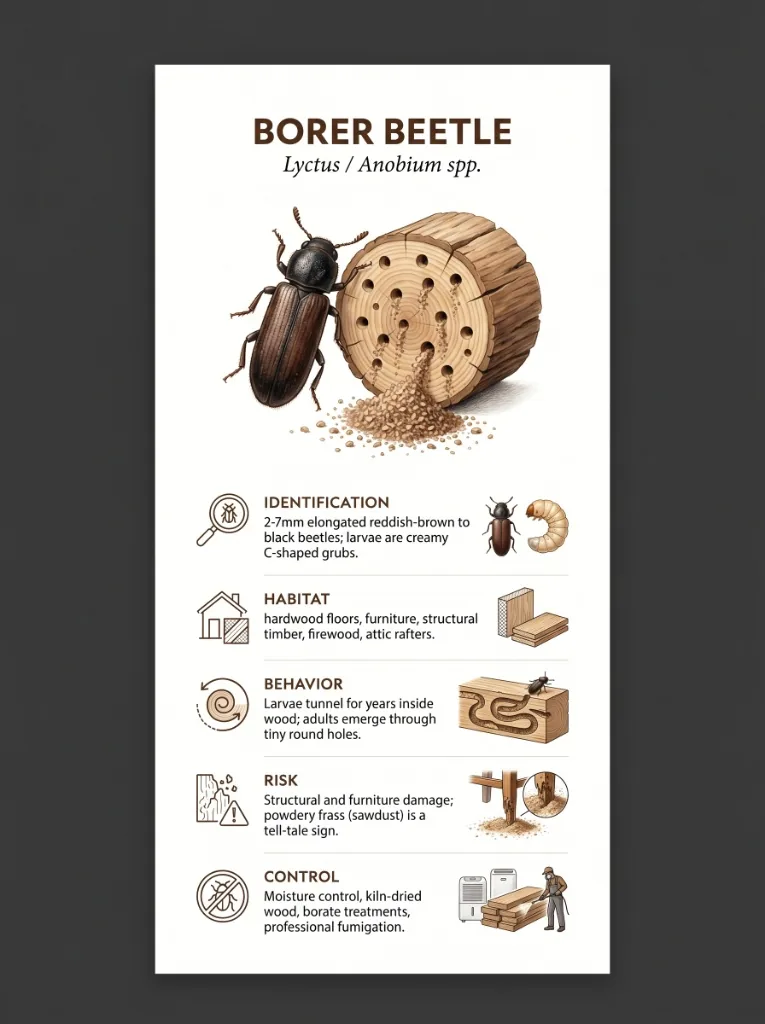
Powderpost / Borer Beetle (Lyctus / Anobium spp.) identification infographic showing size, habitat, behavior, risk, and control
High concern

Powderpost / Borer Beetle — Identification & Control

Lyctus / Anobium spp.

Size
2–7 mm
Category
Wood-Destroying

About the powderpost / borer beetle

Powderpost and related wood-boring beetles (Lyctus, Anobium, and related genera) are a small, patient, often-overlooked wood-destroying pest in North Carolina — and in older Triangle homes they can quietly rival termite damage over time. Adults are small reddish-brown to black beetles, but the damage is done by their larvae, which tunnel through hardwood for months to years before emerging as adults through tiny round exit holes.

The tell-tale sign — and the one most homeowners see first — is a fine powdery frass, exactly like talcum powder, sifting out from those exit holes onto floors, sills, or attic decking. Powderpost beetles are especially common in unfinished hardwood: hardwood floors from before modern kiln-drying standards, oak or hickory rafters in older attics, exposed structural timber in older crawl spaces, and untreated hardwood furniture.

Quick ID

2–7 mm elongated reddish-brown to black beetles; larvae are creamy C-shaped grubs.

In the Triangle

Less common than termites in the Triangle but significant in older homes with original hardwood floors and exposed crawl-space timber.

Think you have powderpost / borer beetles?

Free inspection from a licensed Castle Exterminators technician — Durham, Chapel Hill, Raleigh, Cary & the Triangle. We'll confirm the species and recommend a treatment plan.

Request Free Inspection (919) 606-8686
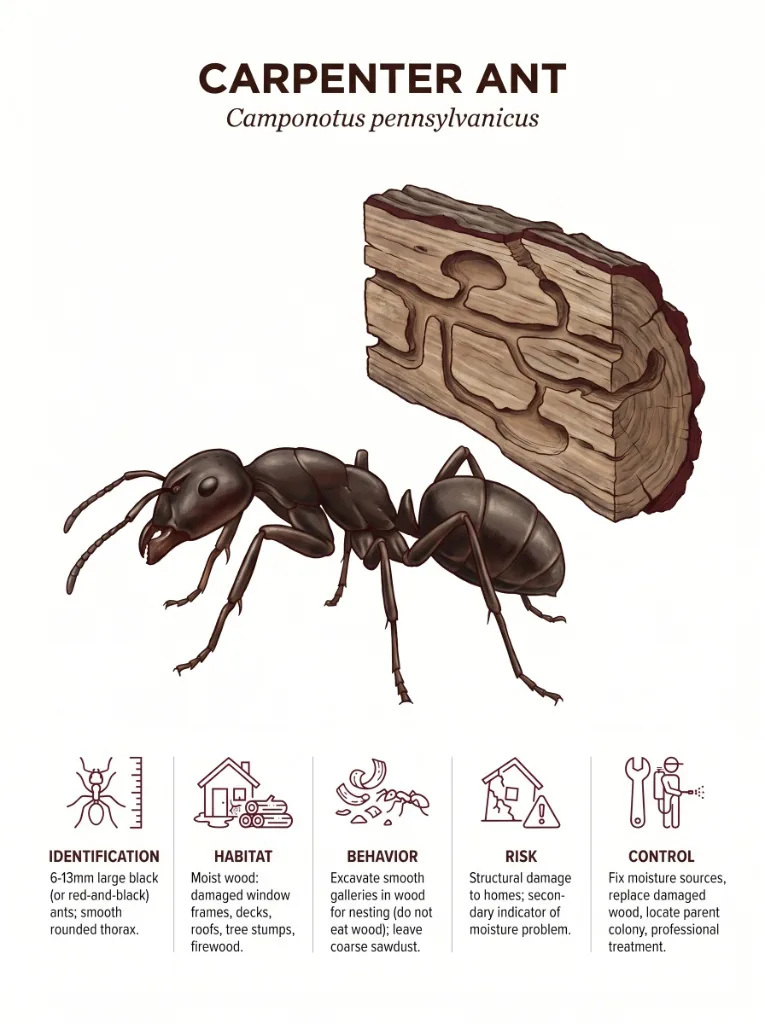
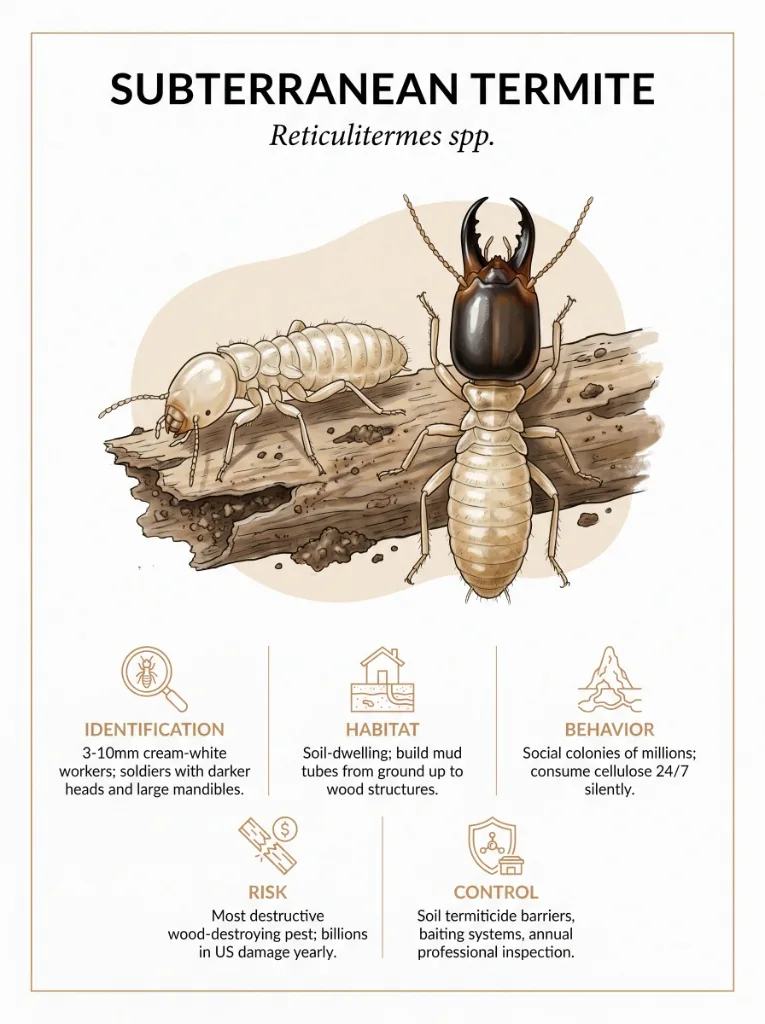
Beetle Species & Wood Preferences

Three families of borer beetles cause the most residential damage in NC:

  • True powderpost beetles (Lyctidae) — attack hardwoods only: oak, ash, hickory, walnut. Common in hardwood floors, cabinets, tool handles, and hardwood structural elements.
  • Anobiid powderpost beetles (Anobiidae, incl. Anobium punctatum & Xestobium) — attack both hardwoods and softwoods; the most common infester of structural timber and crawl-space sills in older Triangle homes.
  • Old-house borer (Cerambycidae, Hylotrupes bajulus) — larger beetle whose larvae make audible chewing sounds; attacks softwood structural timber, especially pine.

Correct identification matters because treatment scope and urgency vary by species. A licensed technician confirms which one you are dealing with during inspection.

Signs of an Active Infestation

  • Round or oval exit holes — pinhole-sized (1-3 mm for powderpost, 6-10 mm for old-house borer) in wood floors, joists, or trim.
  • Fine powdery frass — the powder that sifts out of exit holes; texture ranges from talc-fine (powderpost) to slightly gritty (anobiid) to coarser (old-house borer).
  • Fresh, light-colored frass is a sign of an active infestation. Yellowed, packed-in frass is often historic — the infestation may already be over.
  • Audible chewing from old-house borer larvae in quiet attics on warm days.
  • Blistered or weakened wood — in advanced cases, the wood surface can be pushed in with a fingernail.

Distinguishing an active vs. inactive infestation is a professional call and drives whether treatment is needed at all.

Why Triangle Homes Are Vulnerable

North Carolina's warm, humid climate is favorable to borer beetles because wood moisture content in an unconditioned crawl space or attic stays high enough to support larval development. Older Triangle homes — Trinity Park, Old West Durham, downtown Durham historic districts, Hope Valley, and older Chapel Hill — often have original hardwood flooring, exposed hardwood or pine structural timber, and crawl spaces without modern vapor barriers. That combination is essentially a nursery.

Newer homes are less commonly affected but are not immune: any exposed unfinished wood in a damp crawl space is a potential harborage. This is one of the reasons Castle strongly recommends addressing crawl-space moisture as part of any long-term wood-destroying-organism plan.

Property Damage & Assessment

Borer beetle damage is cumulative. A single generation may not compromise a joist, but successive generations reinfesting the same wood over decades absolutely can. In older Triangle homes we routinely inspect crawl spaces where several floor joists have been effectively hollowed by anobiid activity — and the homeowner had no idea because the damage was on the top of the joist, not visible from below.

Correct assessment answers three questions: (1) which species; (2) active or historic; (3) how much moisture is driving the risk. Those three answers set the treatment plan — from no action needed, to targeted borate application, to structural repair plus fumigation.

Our Treatment & Prevention Approach

Because Castle is a licensed NC Structural Pest Control firm (#1979PW), our WDO (wood-destroying organism) inspections include borer beetles alongside termites and carpenter ants. A typical borer plan involves:

  • Full crawl-space and attic inspection to identify active infestations, distinguish them from historic damage, and locate moisture sources.
  • Borate wood treatments on bare, unfinished wood — an effective active that penetrates the wood and prevents future infestation.
  • Moisture correction — often including vapor barrier, dehumidification, or full crawl-space encapsulation to remove the underlying driver.
  • Targeted structural fumigation in rare cases where an infestation is too widespread for surface treatment.
  • Kiln-dried wood recommendations for any replacement lumber to prevent reintroduction.

Every plan is scoped and priced with a personalized quote based on species, extent, and moisture conditions.

Prevention Tips for Triangle Homeowners

  • Keep crawl-space relative humidity below 55% — this is the single most effective borer beetle prevention.
  • Install and maintain a vapor barrier over exposed soil in the crawl space.
  • Use kiln-dried lumber for any repairs or additions.
  • Do not bring firewood into the house — store it outside, off the ground, and burn it seasonally.
  • Inspect hardwood antique or secondhand furniture for exit holes before bringing it inside.
  • Include borer beetles in your annual WDO inspection alongside termites.
  • Address any active roof or plumbing leak promptly — every source of chronic wood moisture invites infestation.

Frequently asked

Powderpost / Borer Beetle questions homeowners ask

How can I tell if my exit holes are active or old?
Fresh frass is light-colored and loose, and sifts out onto surfaces below the hole. Old frass is yellowed, packed in, and does not fall out when the wood is tapped. Fresh exit holes look sharp-edged and clean; old holes look darkened and rounded. A licensed inspector confirms during on-site inspection — the distinction determines whether treatment is even needed.
Are borer beetles as damaging as termites?
Not per year — termite colonies work faster and consume the wood rather than just tunneling through it. But borer beetles can cause serious cumulative damage over decades in a home with chronic wood moisture, and they are frequently overlooked because the damage is quiet. In older Triangle homes we treat them with the same seriousness as termites.
Can I treat borer beetles myself?
Surface borate treatments are available, but correct application requires bare, unfinished wood; correct identification of the species; and correct assessment of whether the infestation is active. Because borer work almost always ties into a moisture issue, we recommend starting with a professional WDO inspection — the moisture correction is usually the more important half of the fix.
Will crawl space encapsulation stop borer beetles?
It significantly reduces the risk by lowering wood moisture content — the environmental condition borers need. Encapsulation is not a beetle treatment on its own, but it is a powerful long-term prevention tool and is why we frequently pair borate treatment with encapsulation for older Triangle homes.
Do borer beetles spread to nearby homes?
They can spread locally through infested firewood, secondhand furniture, or shared attic space in multifamily buildings — but they do not swarm in the way termites do. Preventing reintroduction is mostly about controlling what wood you bring into the home.

Related pests

More in wood-destroying

Browse all pests