
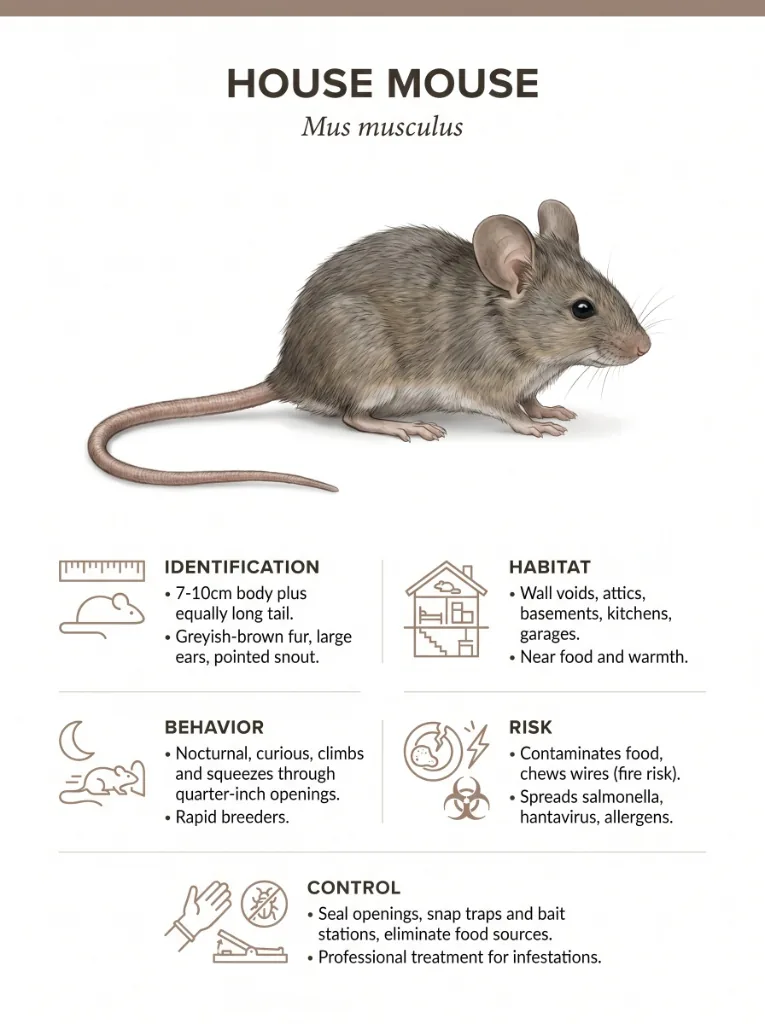
House Mouse (Mus musculus) identification infographic showing size, habitat, behavior, risk, and control
High concern

House Mouse — Identification & Control

Mus musculus

Size
7–10 cm body
Category
Rodents

About the house mouse

The house mouse (Mus musculus) is the most common indoor rodent across North Carolina and, along with the two rats, one of the most consequential pests a Triangle homeowner will deal with. Adults are small — about seven to ten centimeters of body plus a tail of roughly the same length — greyish-brown, with a pointed snout and large ears. What matters more than their size is what they do inside a home.

House mice contaminate stored food with urine and droppings, chew electrical wiring (a well-documented cause of otherwise unexplained house fires), tunnel through insulation, and reproduce fast enough that a single pair introduced in September can be a full-blown infestation by Christmas. Every fall, when the first cool nights hit the Triangle, they push into homes looking for warmth. Effective control combines exclusion, trapping, tamper-resistant bait stations, and sanitation — no single tool works alone.

Quick ID

7–10 cm body plus equally long tail; greyish-brown fur, large ears, pointed snout.

In the Triangle

Universal in Triangle homes during fall and winter when temperatures drop — especially in homes with attached garages or older crawl spaces.

Think you have house mouses?

Free inspection from a licensed Castle Exterminators technician — Durham, Chapel Hill, Raleigh, Cary & the Triangle. We'll confirm the species and recommend a treatment plan.

Request Free Inspection (919) 606-8686

Biology & Reproductive Rate

A female house mouse can produce five to ten litters per year, each of five to seven pups, and those pups reach breeding age in six to eight weeks. Indoors, with climate control and steady food, reproduction is continuous — there is no winter slowdown. That compounds fast. It is why a homeowner who first hears scratching in October can be dealing with dozens of mice by February.

They are also highly mobile and neophobic — cautious around new objects in their environment — which is why professional trap and bait placement matters more than quantity. A properly placed pair of traps in the right runway will out-catch a scattered dozen in bad spots.

How They Get Inside

An adult house mouse can squeeze through any opening a #2 pencil can pass through — roughly a quarter of an inch. That means the entry points people expect (obvious holes, unsealed doors) are only the beginning. In a typical Triangle home the real entry points are:

  • Gaps around plumbing and utility penetrations under sinks and behind washing machines.
  • Unsealed gaps where the sill plate meets the foundation.
  • Gaps around dryer vents, HVAC line sets, and gas-line penetrations.
  • Damaged crawl-space vents and vapor barriers.
  • Garage-door corner seals that no longer meet the concrete.
  • Roof-line gaps at soffit corners and fascia returns.

Any effective rodent job in the Triangle includes a full exclusion inspection, not just trap placement.

Signs of an Active Mouse Infestation

  • Droppings — dark rice-grain-shaped, 3-6 mm, often concentrated along walls, in pantries, in silverware drawers, and behind the stove.
  • Chew marks on cardboard, plastic packaging, wood trim, and — most dangerously — electrical wiring.
  • Scratching or scampering sounds in ceilings, walls, and attics, especially just after dark.
  • Grease marks (rub marks) — dark smudges along baseboards where mice repeatedly follow the same path.
  • Urine smell — a distinct musky odor in heavy infestations, especially in cabinets.
  • Nests — shredded insulation, fabric, and paper tucked into wall voids, drawers, or appliance motor housings.

Health Risks & Property Damage

House mice are documented carriers of salmonella, hantavirus, lymphocytic choriomeningitis (LCMV), and leptospirosis, and they mechanically spread contamination through droppings and urine across pantries and food-prep surfaces. The property-damage side is just as real: chewed insulation loses R-value; chewed wiring is one of the most cited causes of otherwise-unexplained house fires; and chewed HVAC ducts, plumbing insulation, and drywall corners add up to repair bills that dwarf the cost of professional rodent control.

This is why we treat rodent work as both a health and a structural service — not a nuisance call.

Our Rodent Control Approach

Castle's rodent program is built around exclusion first — because trapping without sealing entry points is a treadmill. A typical plan includes:

  • Whole-home inspection — attic, crawl space, garage, plumbing penetrations, roofline, and foundation perimeter — to identify every likely entry.
  • Exclusion work — sealing gaps with rodent-resistant materials (copper mesh, hardware cloth, sealants rated for gnawing) so new mice cannot replace the ones we remove.
  • Interior trapping placed in actual runways along walls and behind appliances — not the middle of a room where mice do not travel.
  • Exterior tamper-resistant bait stations around the perimeter to intercept mice before they enter.
  • Follow-up service until sightings and evidence stop, then transition to ongoing monitoring.

Every plan is scoped and priced with a personalized quote based on the home's size, construction, and current rodent pressure.

Prevention Tips for Triangle Homeowners

  • Seal any gap wider than a quarter-inch around plumbing, utility, and HVAC penetrations.
  • Replace worn garage-door corner seals — one of the top entry points we find.
  • Keep garage-stored pet food, birdseed, and grass seed in hard-sided sealed containers, never in the bag.
  • Store firewood off the ground and at least twenty feet from the house.
  • Trim tree limbs back so branches do not touch the roof or gutters.
  • Keep the kitchen tight overnight — crumbs, cereal spills, uncovered fruit.
  • Do not rely on cats. Cats catch some mice; they do not eliminate infestations.

Frequently asked

House Mouse questions homeowners ask

How can I tell if I have mice or rats?
Mice are small (7-10 cm body), grey-brown, with a tail roughly equal to body length; their droppings are 3-6 mm and rice-grain-shaped. Rats are much larger (18-25 cm body), with droppings 12-18 mm and blunt-ended. The two species have different behavior, entry points, and control strategies, so a correct ID matters. A licensed technician can confirm during the free inspection.
Do peppermint oil, ultrasonic repellers, or dryer sheets work?
These circulate online constantly, but there is no reliable research evidence they eliminate an established mouse infestation. They may temporarily displace individual mice from a small area, at best. Professional rodent control uses exclusion, targeted trapping, and tamper-resistant baiting for a reason — it actually resolves the problem.
How long does it take to get rid of mice?
Initial population reduction usually happens within the first one to two weeks after exclusion and trapping are in place. Full resolution — the point where evidence and sightings stop — is typically achieved within four to eight weeks depending on infestation size. We stay on the account until we confirm the home is clear.
Are the baits safe around pets and kids?
Every exterior rodent bait we deploy is inside a locked, tamper-resistant bait station specifically designed to keep pets and children out. Interior control emphasizes traps over loose bait for the same reason. Every technician is licensed by the NC Structural Pest Control Committee and follows label rates.
Will one mouse in the kitchen become an infestation?
It can, quickly. Mice reproduce continuously indoors, and if one squeezed in, the entry point is still there for more. The right response to a single sighting is a professional inspection to find and seal the entry — treating the entry point matters more than removing that one mouse.

Related pests

More in rodents

Browse all pests