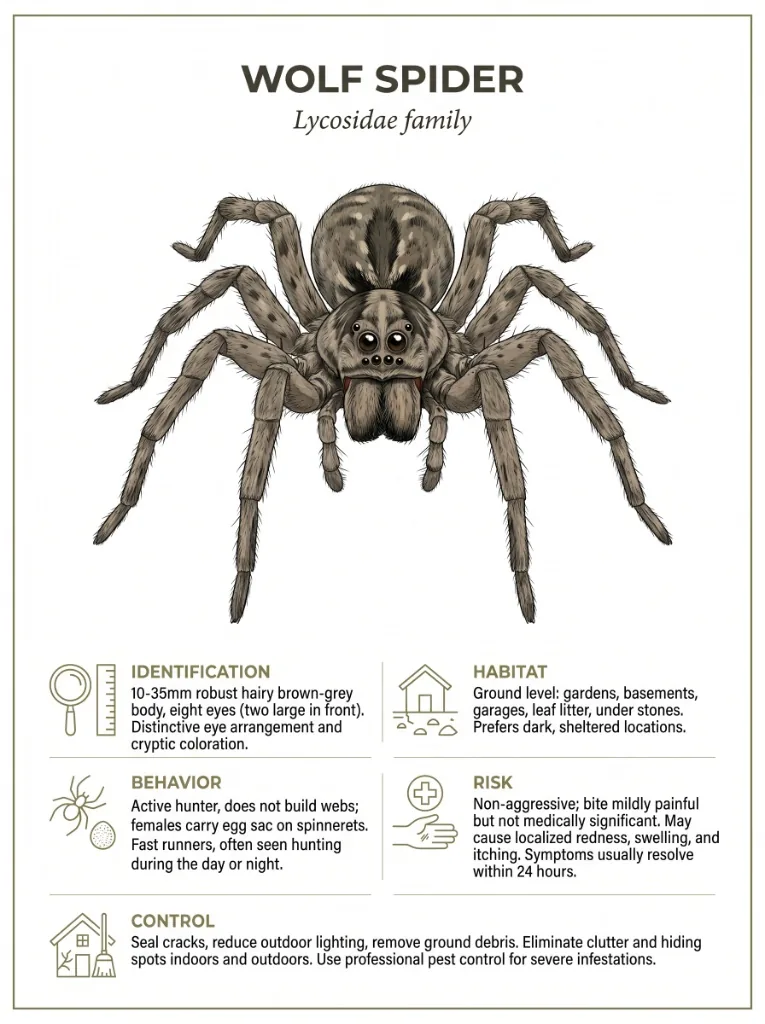
Wolf Spider (Lycosidae family) identification infographic showing size, habitat, behavior, risk, and control
Low concern

Wolf Spider — Identification & Control

Lycosidae family

Size
10–35 mm
Category
Spiders

About the wolf spider

Wolf spiders (family Lycosidae) are the large, fast, ground-hunting spiders Triangle homeowners often panic about — usually because they saw one running across the basement floor or the garage at speed. Adults range from 10-35 mm in body length depending on species, with equally long powerful legs. They are hairy, robust-looking, and typically mottled brown-to-grey with darker markings that provide leaf-litter camouflage.

Wolf spiders are the North Carolina spider most frequently misidentified as a brown recluse — but the two are easy to tell apart once you know what to look for. Wolf spiders are not medically significant; their bites are painful but do not cause the necrotic wounds sometimes attributed to recluses. They are also excellent predators of insects, roaches, and small pests, and one wolf spider in a garage or basement is usually doing more good than harm.

Quick ID

10–35 mm robust hairy brown-grey body; two large eyes facing forward; carries egg sac on spinnerets.

In the Triangle

Common throughout the Triangle, especially in basements, garages, mulched landscapes, and leaf litter.

Think you have wolf spiders?

Free inspection from a licensed Castle Exterminators technician — Durham, Chapel Hill, Raleigh, Cary & the Triangle. We'll confirm the species and recommend a treatment plan.

Request Free Inspection (919) 606-8686
Identifying Wolf Spiders

  • Body — 10-35 mm, robust, hairy, brown-to-grey with darker chevron or striped markings.
  • Legs — long, powerful, and BANDED — light and dark alternating stripes. This is one of the fastest field IDs.
  • Eyes — eight eyes in three rows (bottom row of four small eyes, middle row of two large eyes, top row of two medium eyes). The two large forward-facing eyes are highly reflective at night — flashlight reveals them at a distance.
  • Behavior — runs fast; does NOT build webs; hunts by chasing prey down on the ground.
  • Egg sacs — attached to the female's spinnerets and carried behind her; hatchlings climb onto her abdomen and ride until their first molt.

The three key distinctions from brown recluse: eight eyes vs. six, banded legs vs. uniform, and hairy vs. smooth. Any spider with banded legs is not a recluse.

Behavior & Ecology

Wolf spiders are active hunters. They do not build webs — they chase down prey on foot, relying on speed and powerful jaws to catch insects, small roaches, crickets, and other ground-dwelling arthropods. That makes them beneficial predators, and one wolf spider in a garage or basement is generally reducing the pest load rather than causing problems.

Females carry an egg sac attached to their spinnerets — a distinctive silhouette when you see one. After hatching, spiderlings climb onto the mother's abdomen and ride until their first molt. Seeing a female wolf spider covered in dozens of tiny hitchhikers is startling but harmless.

Wolf Spider vs. Brown Recluse: Fast ID

This is the single most common misidentification in NC pest calls. The differences:

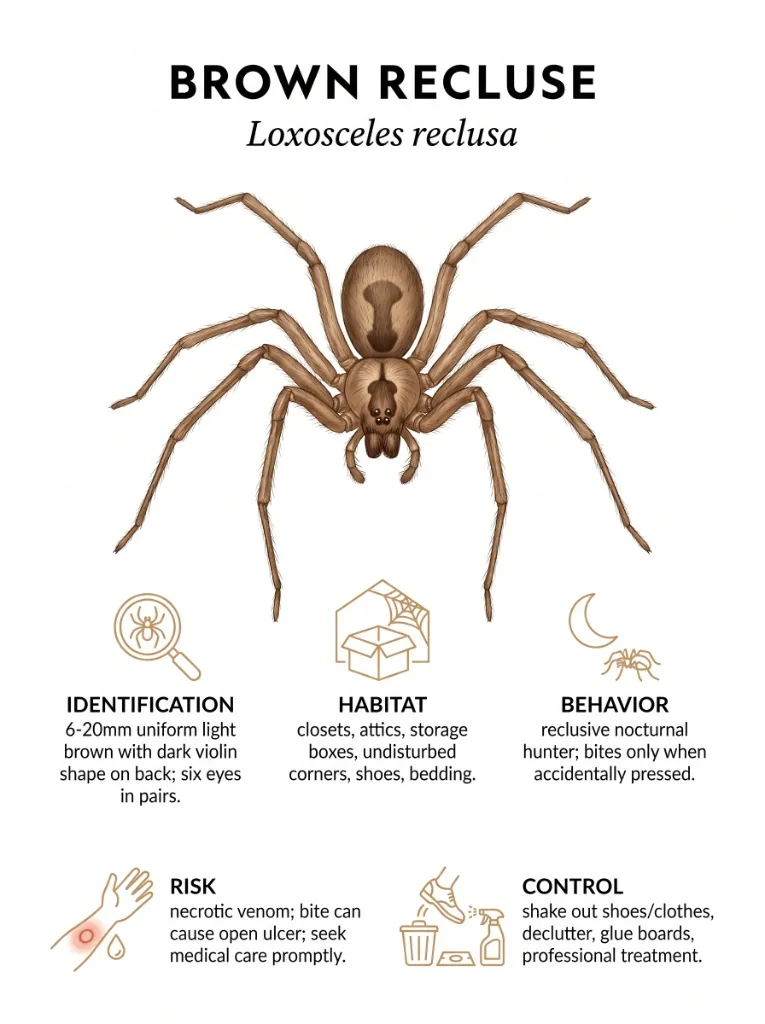
  • Eyes — wolf spider has eight eyes in three rows; brown recluse has six eyes in three pairs.
  • Legs — wolf spider legs are BANDED (light and dark stripes); brown recluse legs are uniform tan-brown.
  • Body — wolf spider is HAIRY; brown recluse is SMOOTH.
  • Size — wolf spider bodies are typically larger (up to 35 mm); brown recluses are 6-20 mm.
  • Marking — brown recluse has a violin marking on the cephalothorax; wolf spiders have chevron/striped body markings.

If a spider you found has banded legs, is hairy, or is bigger than a quarter, it is not a brown recluse. A licensed inspector can confirm identification during the free inspection.

Are Wolf Spider Bites Dangerous?

No. Wolf spider bites are painful — they have large fangs and strong grip — but the venom is not medically significant. A bite produces a localized red swollen area with pain that fades over hours. Systemic reactions are rare. Necrotic lesions are not a feature of wolf spider bites, contrary to occasional online claims.

They are also unlikely to bite unless directly handled or pressed against skin. They flee first and only bite when trapped. If bitten, wash the area, apply cold compress, take a common analgesic if needed, and monitor. See a physician if the reaction seems out of proportion — but wolf spider bite is essentially never the answer to a serious skin lesion.

Where They Live in Triangle Homes

Wolf spiders are outdoor spiders that occasionally wander indoors, especially in fall as temperatures drop. In Triangle homes we typically find them in:

  • Basements — running along walls, especially in fall.
  • Garages, especially near open doors or garage-door corner gaps.
  • Crawl spaces (rarely accessed by homeowners, so often present unseen).
  • First-floor rooms adjacent to attached garages.
  • Around porch and patio lights at night, hunting flying insects.
  • Occasionally in upper-floor rooms after climbing exterior walls or through open windows.

Outdoor populations concentrate in mulch beds, leaf litter, ground cover, stone walls, and any dense low vegetation.

Our Approach: Perimeter Reduction

Wolf spider control is primarily an exterior perimeter and entry-point job:

  • Perimeter residual treatments along foundation, mulch bed edges, garage-door corners, and basement windows.
  • Entry-point sealing — worn garage-door corner seals, gaps at garage service-door thresholds, cracked basement window screens.
  • Interior spot treatments in basements, garages, and utility rooms where entry is confirmed.
  • Landscape recommendations — pulling mulch beds and dense ground cover back from foundation reduces outdoor populations near entry points.
  • Ongoing quarterly perimeter service for chronic-pressure properties.

Every plan is scoped with a personalized quote based on landscape conditions and entry-point findings.

Safety & Prevention Tips

  • Do not handle a wolf spider bare-handed even though the bite is not medically significant — the bite itself is painful.
  • Repair worn garage-door corner seals — the #1 wolf spider entry point in most Triangle homes.
  • Pull mulch back from the foundation; keep ground cover trimmed away from garage service doors and basement windows.
  • Screen basement window wells.
  • Reduce clutter in garages and basements — wolf spiders shelter under stored items.
  • Improve exterior lighting; wolf spiders hunt around light attractants, so light zones near doorways attract them.
  • Teach children to identify wolf spiders (hairy, banded legs, big) as harmless but not for handling.

Frequently asked

Wolf Spider questions homeowners ask

Are wolf spiders dangerous?
No. Wolf spider bites are painful but not medically significant — no necrotic lesions, no systemic venom effect. They flee before biting unless directly handled or pressed against skin. They are useful ground-hunting predators of insects and small pests.
How can I tell a wolf spider from a brown recluse?
Wolf spiders have eight eyes in three rows, hairy bodies, and BANDED legs (light and dark stripes). Brown recluses have six eyes in three pairs, smooth bodies, and uniform tan legs. Any spider with banded legs is not a recluse. Wolf spiders are also typically much larger.
Why do I only see them in the fall?
Wolf spiders are outdoor spiders that wander indoors seeking shelter as autumn temperatures drop. Peak fall entry in the Triangle is October and November. This is when perimeter treatments have the most preventive value — treating the exterior in early fall dramatically reduces indoor sightings.
Should I kill a wolf spider I find in my basement?
Ecologically, one or two wolf spiders in a garage or basement are net-beneficial — they hunt roaches, crickets, and other insects. Many homeowners are willing to leave them alone and let them do that job. If the presence bothers you, capture in a jar and release outside, or call for perimeter service that reduces overall entry.
Will general pest control reduce wolf spiders?
Yes. A perimeter residual treatment substantially reduces wolf spider entry into the home, especially when combined with landscape adjustments and entry-point sealing. Chronic-pressure properties benefit from ongoing quarterly service.

Related pests

More in spiders

Browse all pests