
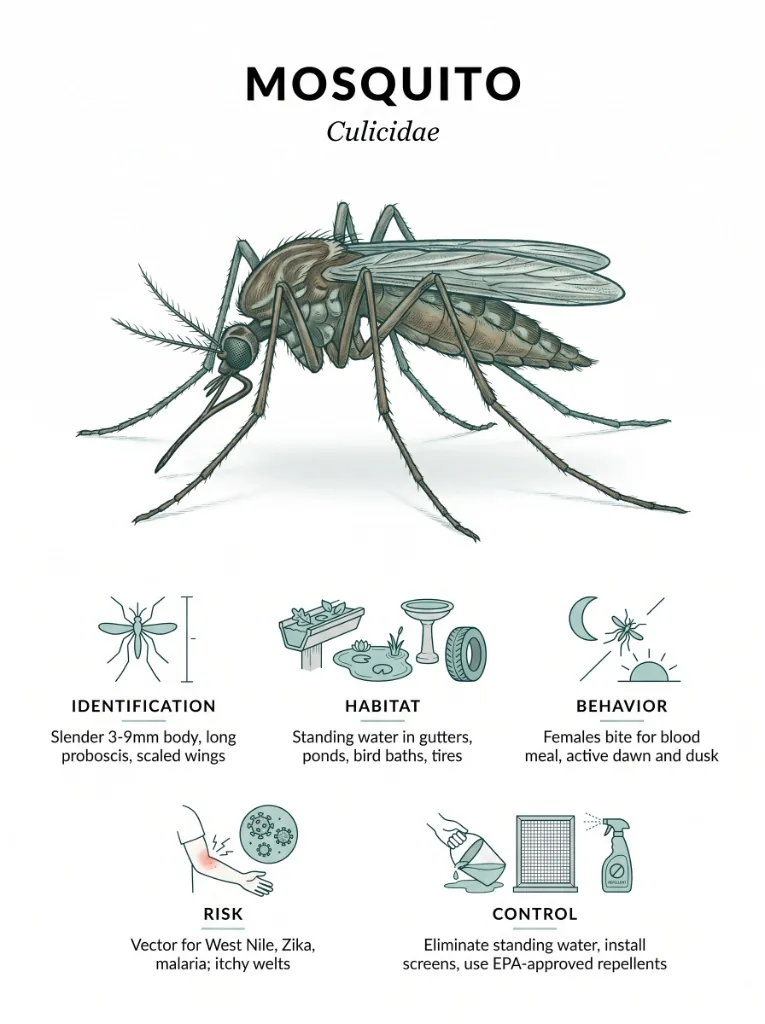
Mosquito (Culicidae family) identification infographic showing size, habitat, behavior, risk, and control
High concern

Mosquito (Culicidae family) — Identification & Biology

Culicidae family

Size
3–9 mm
Category
Biting Pests

About the mosquito

Mosquitoes are the most consequential biting pest in North Carolina — not just because they are irritating, but because they are the single deadliest animal group on the planet from a disease-vector standpoint. In the Triangle we routinely deal with several species, most notably the Asian tiger mosquito (Aedes albopictus) which is aggressive, day-biting, and thrives in suburban yards; the common house mosquito (Culex pipiens); and various floodwater and container species that emerge after summer rains.

The Triangle's warm humid summers, wooded lots, ornamental water features, and dense residential development all favor mosquito production. A single female produces dozens of eggs per batch and can complete generations in as little as eight to ten days in peak summer. Effective backyard mosquito control combines habitat elimination, larval-source management, and adult-targeted barrier treatments — no single tool wins alone.

Quick ID

Slender 3–9 mm body with long proboscis and scaled wings.

In the Triangle

Triangle mosquito season runs roughly April through October; worst near creeks, ponds, and wooded areas.

Think you have mosquitos?

Free inspection from a licensed Castle Exterminators technician — Durham, Chapel Hill, Raleigh, Cary & the Triangle. We'll confirm the species and recommend a treatment plan.

Request Free Inspection (919) 606-8686
Mosquito Species in the Triangle

  • Asian tiger mosquito (Aedes albopictus) — the #1 backyard biter in the Triangle. Aggressive, day-active, breeds in tiny amounts of standing water (bottle caps, plant saucers, gutters). Distinctive black-and-white striped legs.
  • Common house mosquito (Culex pipiens) — the primary West Nile virus vector in NC. Larger, brown, active at dawn/dusk, breeds in stagnant standing water (birdbaths, ditches, storm drains).
  • Floodwater mosquitoes (Aedes vexans and related) — emerge in swarms after heavy summer rains from temporary pooled water.
  • Container mosquitoes — several species that specialize in artificial containers (tires, buckets, tarps, kiddie pools).

Each species has different biting behavior and different breeding preferences, which is why professional treatment addresses the whole yard's habitat, not just adults on the wing.

Diseases Mosquitoes Can Carry in NC

Mosquito-borne disease risk in the Triangle is real, though case counts vary year to year. The main concerns:

  • West Nile virus — endemic in NC, primarily via Culex mosquitoes. Most infections are mild or asymptomatic, but severe cases (encephalitis, meningitis) occur.
  • Eastern equine encephalitis (EEE) — rare but serious; horse vaccinations are standard in NC for this reason.
  • La Crosse encephalitis — noted in mountain NC, particularly affecting children.
  • Zika, dengue, chikungunya — transmitted by Aedes mosquitoes and periodically reported in travelers returning to NC; local transmission has not been established but the vector is present.
  • Dog heartworm — a year-round mosquito-transmitted parasite; all Triangle dogs should be on veterinarian-prescribed prevention.

Personal repellents plus a treated yard significantly reduce both bite counts and disease exposure.

Where They're Breeding in Your Yard

Every mosquito control conversation should start with breeding-site elimination — because a treated yard with active breeding sites will keep producing new mosquitoes. Common Triangle breeding sites people miss:

  • Plant saucers under potted plants — top mosquito nursery in most yards.
  • Clogged gutters holding organic debris and water.
  • Birdbaths (change water twice a week or add a small pump).
  • Corrugated downspout extensions that never fully drain.
  • Kids' toys, kiddie pools, wagons, sandbox lids.
  • Old tires or rims stored outdoors.
  • Tarps, boat covers, and grill covers with folds that hold rainwater.
  • Recycling bins left uncovered.
  • Ornamental ponds without fish or aeration.
  • Tree holes and rot cavities in mature trees.

Aedes species — including the Asian tiger — need only a teaspoon of standing water to breed.

Why the Triangle Is a Mosquito Hot Zone

Central NC's summer climate is essentially designed for mosquitoes: temperatures in the 80s and 90s, high humidity, frequent afternoon thunderstorms creating fresh standing water, and long warm seasons that let multiple generations reproduce. Add typical Triangle landscape features — mature tree canopy providing shade, ornamental water features, dense residential lots with vegetation and gutters — and the pressure is high in almost every neighborhood.

Wooded neighborhoods (Duke Forest, Hope Valley, older Chapel Hill, Umstead-adjacent Raleigh) see the highest pressure, but even open new subdivisions produce heavy Aedes populations from artificial container breeding.

Our Mosquito Control Approach

Effective yard mosquito control is not a one-shot spray — it is a season-long integrated program:

  • Yard walkthrough — identifying every likely breeding site and flagging what needs elimination.
  • Larval-source management — targeted larvicide (Bti products, methoprene) in standing water that can't be easily eliminated (drains, ornamental ponds, rain barrels).
  • Barrier treatments on foliage — where adult mosquitoes rest during the day (undersides of leaves, dense shrubs, shaded fence lines). Treatments knock down active adults and provide residual protection.
  • Recurring service on a season-appropriate cycle — typically every 3-4 weeks through peak season.
  • Tick treatment add-on — the same barrier zones that harbor mosquitoes host ticks; combining treatments is efficient.

Every plan is scoped and priced with a personalized quote based on lot size, tree canopy, and current pressure.

Personal Protection Tips

  • Dump standing water from plant saucers, birdbaths, buckets, and toys twice a week.
  • Keep gutters clean and free-flowing.
  • Wear EPA-registered repellents (DEET, picaridin, oil of lemon eucalyptus) during outdoor time.
  • Wear long sleeves and pants at dawn and dusk when Culex activity peaks.
  • Repair torn window screens.
  • Run fans on the patio — mosquitoes are weak flyers and struggle against airflow.
  • Consider permethrin-treated outdoor clothing for camping or heavy exposure.
  • Keep pets on year-round veterinarian-prescribed heartworm prevention.

Frequently asked

Mosquito questions homeowners ask

How long does professional mosquito treatment last?
A properly applied barrier treatment provides significant knockdown of active adults and residual protection for approximately three to four weeks in peak Triangle summer conditions — shorter after heavy rains or extreme heat. That is why season-long programs run on a recurring cycle rather than as a single treatment.
Do candles, tiki torches, and citronella actually repel mosquitoes?
They provide very short-range, limited effect immediately next to the flame. They don't reliably protect a whole patio, and they don't reduce the mosquito population in the yard. Effective backyard control combines habitat elimination with professional barrier treatments — the candle is a supplement, not a solution.
Are mosquito treatments safe for kids, pets, and pollinators?
The products we use are EPA-registered for residential use and applied at label rates by NC-licensed technicians. Applications are timed and placed to protect pollinators — treatments target foliage where mosquitoes rest, not open flowers where bees forage. Any specific concerns (edible gardens, sensitive family members, koi ponds) are discussed and accommodated during the walkthrough.
Will one visit fix my mosquito problem?
It will substantially reduce your adult mosquito population for several weeks. It will not stop reintroduction from surrounding yards, floodwater emergence after storms, or new eggs hatching from breeding sites we could not eliminate. That is why recurring season-long service is the norm, not a single visit.
Do I need to add tick control?
For wooded lots, properties adjacent to natural areas, or homes with dogs, yes — the same barrier zones that harbor mosquitoes host ticks, and tick-borne disease in NC has been rising. Our outdoor plan can be scoped as mosquito-only or combined mosquito & tick; every quote is personalized.

Related pests

More in biting pests

Browse all pests