
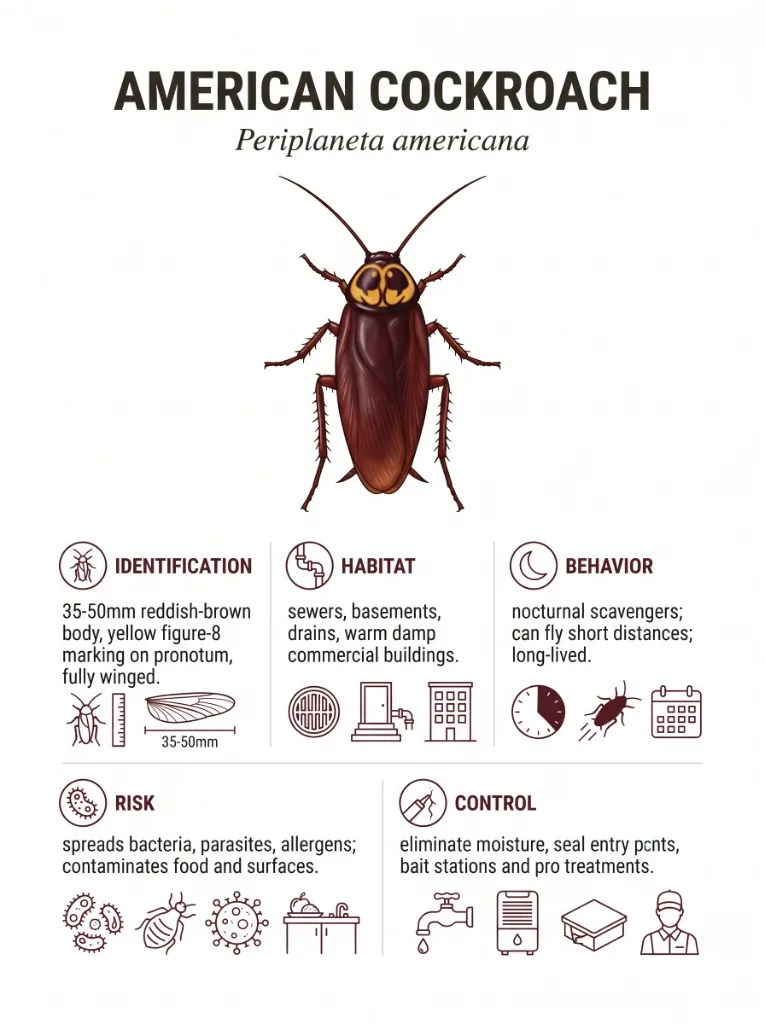
American Cockroach (Periplaneta americana) identification infographic showing size, habitat, behavior, risk, and control
High concern

American Cockroach — Identification & Cockroach Control

Periplaneta americana

Size
35–50 mm
Category
Cockroaches

About the american cockroach

The American cockroach (Periplaneta americana) — often called a 'waterbug' or 'palmetto bug' in North Carolina — is the largest cockroach a Triangle homeowner is likely to encounter. Adults are impressive: 35-50 mm long, reddish-brown, glossy, with fully developed wings and a light yellowish figure-8 marking behind the head. They can fly short distances and run remarkably fast.

Unlike the strictly-indoor German cockroach, American cockroaches primarily live outdoors in the Triangle — in sewer systems, storm drains, mulch beds, tree holes, wood piles, and crawl spaces. They enter homes opportunistically, especially during hot dry spells (when they seek moisture) and heavy rain events (when they flee flooded outdoor habitat). Because they are usually large solitary indoor sightings rather than population infestations, treatment approach differs sharply from German cockroach work.

Quick ID

35–50 mm reddish-brown body with a yellow figure-8 marking on the pronotum; fully winged.

In the Triangle

Frequent in Triangle restaurants, basements, and older downtown commercial buildings.

Think you have american cockroachs?

Free inspection from a licensed Castle Exterminators technician — Durham, Chapel Hill, Raleigh, Cary & the Triangle. We'll confirm the species and recommend a treatment plan.

Request Free Inspection (919) 606-8686
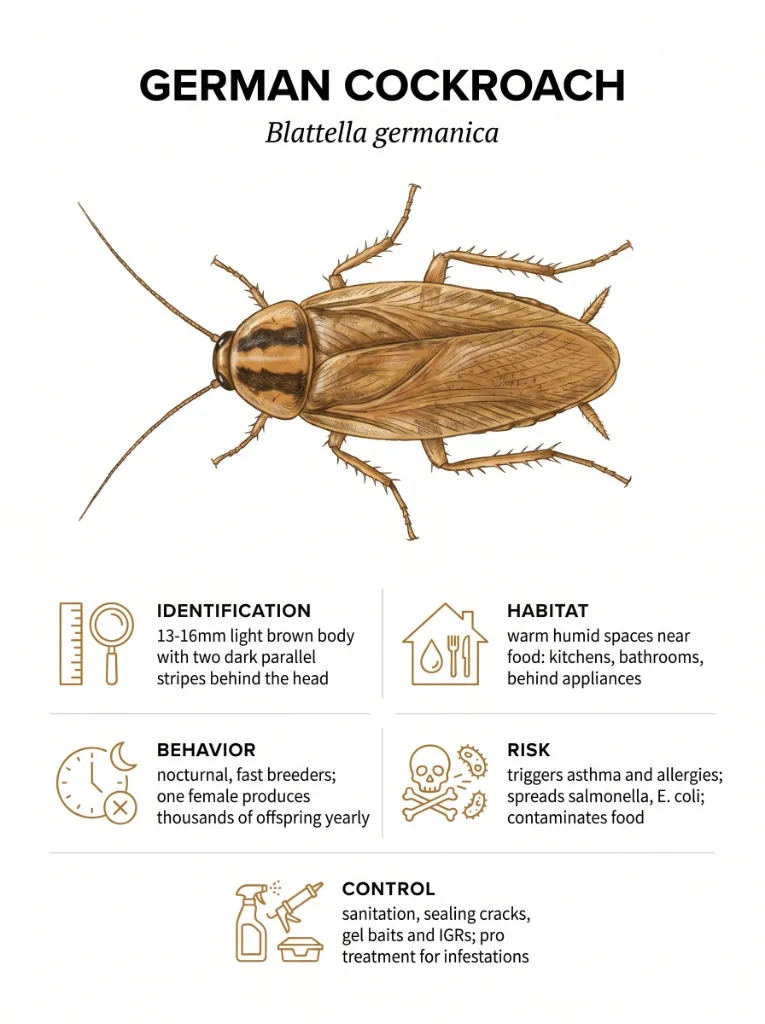
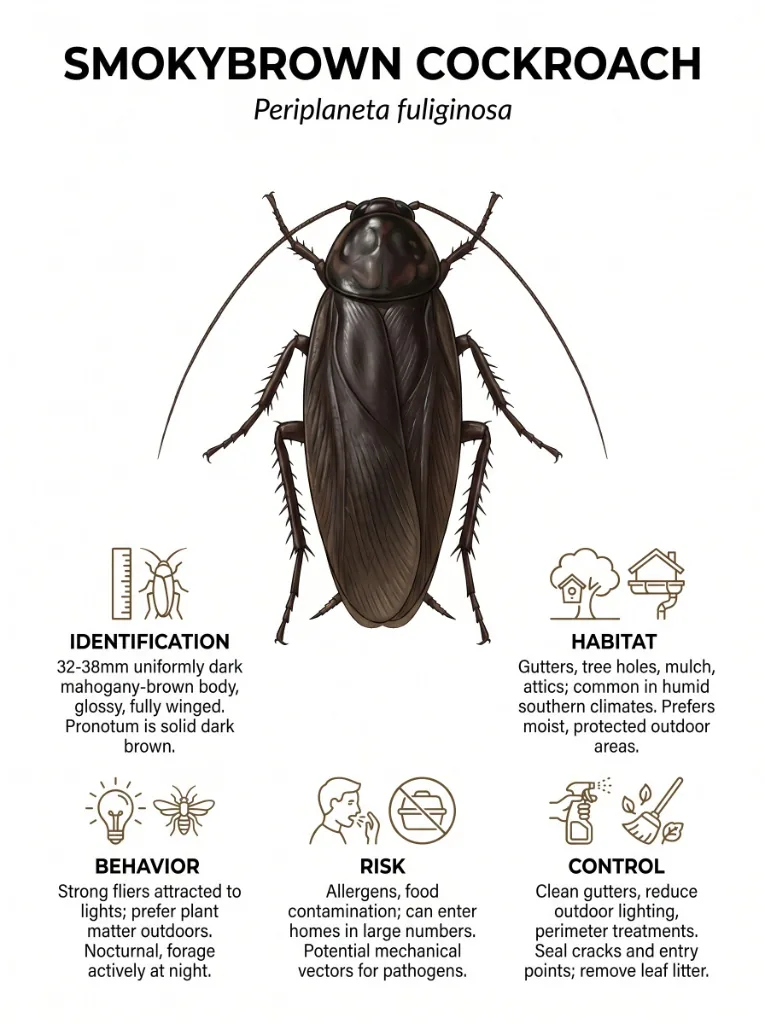
American Cockroach vs. German Cockroach

These two species look superficially similar but represent entirely different pest problems:

  • American cockroach — 35-50 mm, reddish-brown, wings cover the abdomen, light yellow figure-8 behind the head. Primarily OUTDOOR. Indoor sightings are usually individual invaders. Prefers sewers, drains, mulch, crawl spaces.
  • German cockroach — 13-16 mm, light brown with two dark parallel stripes behind the head. Strictly INDOOR. Sightings mean a breeding population is present. Prefers kitchens and baths.

A single 40 mm 'waterbug' in the bathroom is almost certainly an American cockroach — annoying, but usually not evidence of an indoor infestation. Multiple 15 mm brown roaches in the kitchen at night is a German cockroach breeding population that needs urgent professional treatment.

Biology & Life Cycle

American cockroaches are the longest-lived cockroach species most homeowners encounter. Adults can live one to two years. Females produce dark-brown ridged egg capsules (oothecae) — about 8 mm long — that contain fourteen to sixteen eggs. She glues each capsule to a protected surface near food and moisture. In outdoor Triangle conditions, developmental time from egg to adult can take six months to over a year.

Outdoor populations concentrate in sewers, storm drains, tree holes, mulch beds, wood piles, and any consistently moist harborage. Where a home connects to that harborage — via a sewer lateral, a garage floor drain, a crawl-space vent — indoor sightings follow.

Where They Come From (and Why)

Common Triangle entry paths for American cockroaches:

  • Sewer laterals — cracked or open lines allow travel from municipal sewers into wall voids.
  • Floor drains in garages, basements, laundry rooms, and utility rooms.
  • Toilets and sinks in rarely-used bathrooms where the P-trap has dried out (breaking the water seal).
  • Crawl-space vents and vapor barrier gaps.
  • Garage doors with worn corner seals.
  • Attached mulch beds — especially cypress or pine bark against the foundation.
  • Utility penetrations under sinks and behind washing machines.

Peak indoor sightings correlate with hot dry weather (they seek moisture) and heavy summer thunderstorms (they flee flooded outdoor habitat, especially sewers).

Health & Sanitation Concerns

Because American cockroaches spend most of their time in sewers, drains, and decaying organic matter, they mechanically carry salmonella, E. coli, and various other pathogens on their bodies. When they enter the home and traverse counters, cabinets, and food-prep surfaces, that contamination transfers. Their cast skins and droppings are also documented asthma and allergy triggers, though at lower profile than German cockroach allergens.

The health risk from occasional individual invaders is low; the risk from an established indoor population — rare but possible in properties with chronic moisture and sewer defects — is real.

Why the Triangle Sees So Many "Waterbugs"

Central NC's warm humid climate, extensive suburban storm-drain systems, mulched landscape beds, older residential sewer laterals, and hot summer conditions favor American cockroach populations. Older Durham neighborhoods with original sewer laterals see the most consistent indoor sightings. Newer subdivisions with mulch beds against the foundation, crawl-space vents at grade, and irrigation systems also see periodic invasions.

Peak indoor sighting season in the Triangle is late June through early September — the hottest, wettest, and most sewer-flushing months.

Our Treatment & Prevention Approach

American cockroach control is different from German cockroach control:

  • Perimeter treatment — targeted residuals along the foundation, mulch bed edges, garage-door corners, and crawl-space vents.
  • Crack-and-crevice treatments at sink pedestals, floor drains, and utility penetrations.
  • Bait placements in garage, laundry, utility room, and crawl-space harborage points.
  • Sewer-lateral inspection referral where sewer entry is suspected.
  • Crawl-space moisture assessment — American cockroaches love damp crawl spaces; encapsulation reduces harborage significantly.
  • Ongoing quarterly exterior service in high-pressure Triangle properties.

Every plan is scoped with a personalized quote based on property conditions and sighting frequency.

Prevention Tips for Triangle Homeowners

  • Run water in rarely-used sinks, tubs, and floor drains weekly to keep P-traps full — the dried P-trap is a top invasion path.
  • Pull mulch beds back at least 15 cm from the foundation.
  • Fix crawl-space moisture issues; consider encapsulation for chronic problems.
  • Repair or replace worn garage-door corner seals.
  • Seal utility penetrations under sinks and behind appliances.
  • Screen crawl-space vents with fine mesh where not already done.
  • Keep exterior lighting off or on motion sensors — bright lights attract flying American cockroaches at night.
  • Keep firewood at least 20 feet from the house and elevated off the ground.

Frequently asked

American Cockroach questions homeowners ask

Is a "waterbug" the same as a cockroach?
In North Carolina, the term "waterbug" or "palmetto bug" is essentially always referring to an American cockroach. True aquatic waterbugs are a different insect that lives in ponds — you almost never see them in a home. If you saw a large reddish-brown roach indoors, it was an American cockroach.
One roach is not an infestation — right?
For American cockroaches specifically, a single indoor sighting is often just an outdoor invader that wandered in. Repeated sightings, sightings in multiple rooms, or evidence like egg capsules or droppings suggest something more, and warrant an inspection. For any German cockroach sighting the story is different — one seen means many hidden.
Are American cockroaches dangerous?
They mechanically carry bacteria from sewers and drains onto surfaces they walk across, which is the main hygiene concern. They are not aggressive, do not bite meaningfully, and their allergen risk is lower than German cockroaches. The main issue is contamination — treat any surface they crossed as needing to be cleaned.
Why do I see them mostly in summer?
Central NC summer produces peak outdoor American cockroach populations, and the hottest driest days plus heaviest thunderstorm days push them indoors seeking moisture or fleeing flooded sewers. Their outdoor life cycle also puts more mature adults into flight in late summer, when kitchen and bathroom sightings peak.
Will quarterly pest control eliminate them?
Yes, in most Triangle properties an ongoing exterior perimeter service dramatically reduces American cockroach entry. Where sightings persist, it usually points to a sewer-lateral, crawl-space, or moisture problem that also needs correction. Every quote is personalized to what your property actually needs.

Related pests

More in cockroaches

Browse all pests