
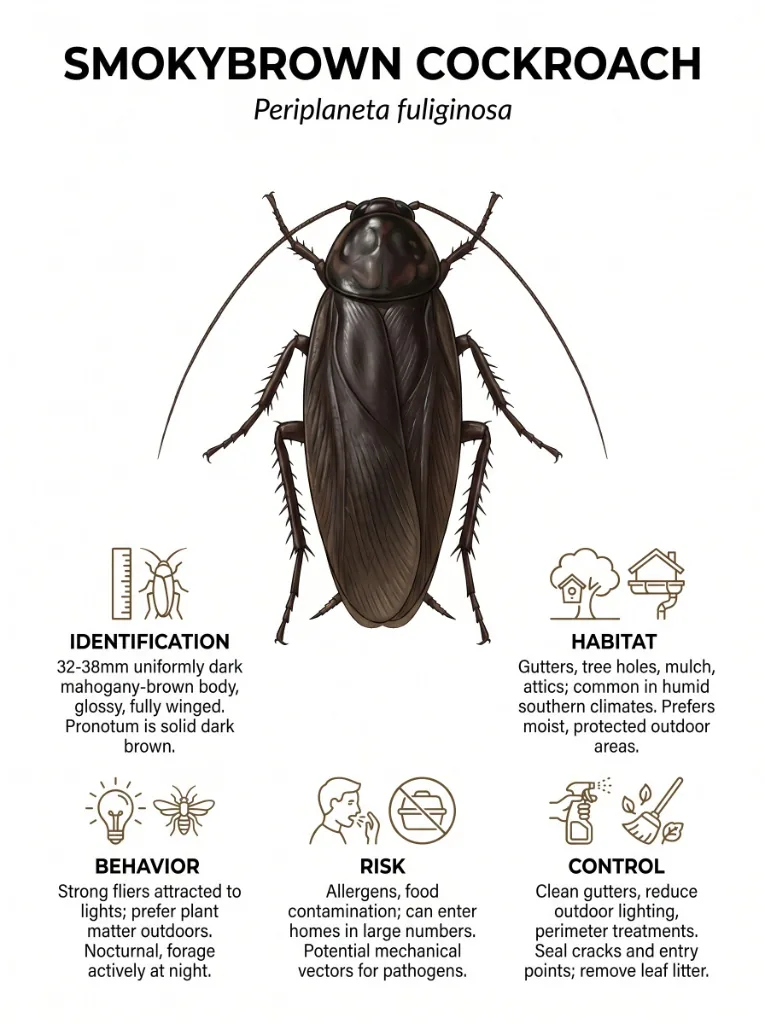
Smokybrown Cockroach (Periplaneta fuliginosa) identification infographic showing size, habitat, behavior, risk, and control
Moderate concern

Smokybrown Cockroach — Identification & Control

Periplaneta fuliginosa

Size
32–38 mm
Category
Cockroaches

About the smokybrown cockroach

The smokybrown cockroach (Periplaneta fuliginosa) is a close relative of the American cockroach and one of the most common outdoor roaches in North Carolina — especially in yards with heavy tree canopy, mulched beds, and mature landscape features. Adults are 32-38 mm, uniformly mahogany-brown to nearly black, with a glossy body and long wings that cover the abdomen. Unlike Americans, they lack the yellow figure-8 marking behind the head.

Smokybrowns are strong flyers and are attracted to lights at night, which is why they routinely land on Triangle porches, screen doors, and garage floors on summer evenings. Their harborage is almost always outdoor — hollow trees, mulch beds, tree canopy, gutters full of leaf litter, attic vents — but they enter homes readily through soffit gaps, attic vents, unscreened chimneys, and lit-up doorways.

Quick ID

32–38 mm uniformly dark mahogany-brown body; pronotum is solid dark brown; fully winged.

In the Triangle

Common Triangle outdoor roach — especially in wooded properties around Duke Forest, Chapel Hill, and Hope Valley.

Think you have smokybrown cockroachs?

Free inspection from a licensed Castle Exterminators technician — Durham, Chapel Hill, Raleigh, Cary & the Triangle. We'll confirm the species and recommend a treatment plan.

Request Free Inspection (919) 606-8686
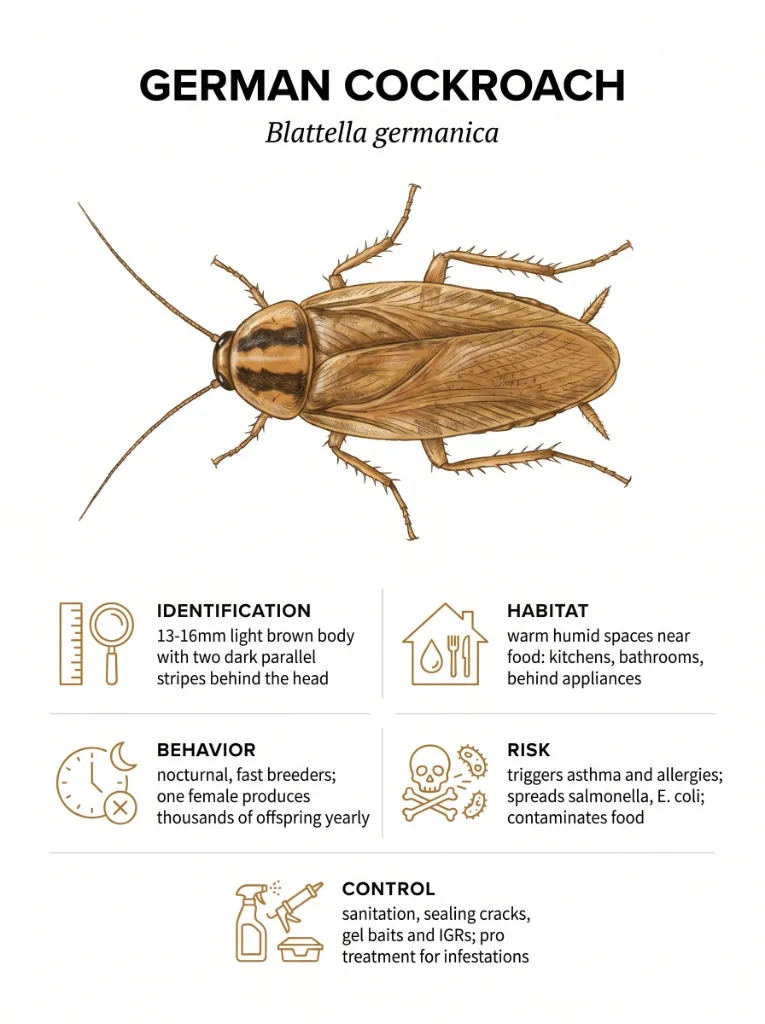
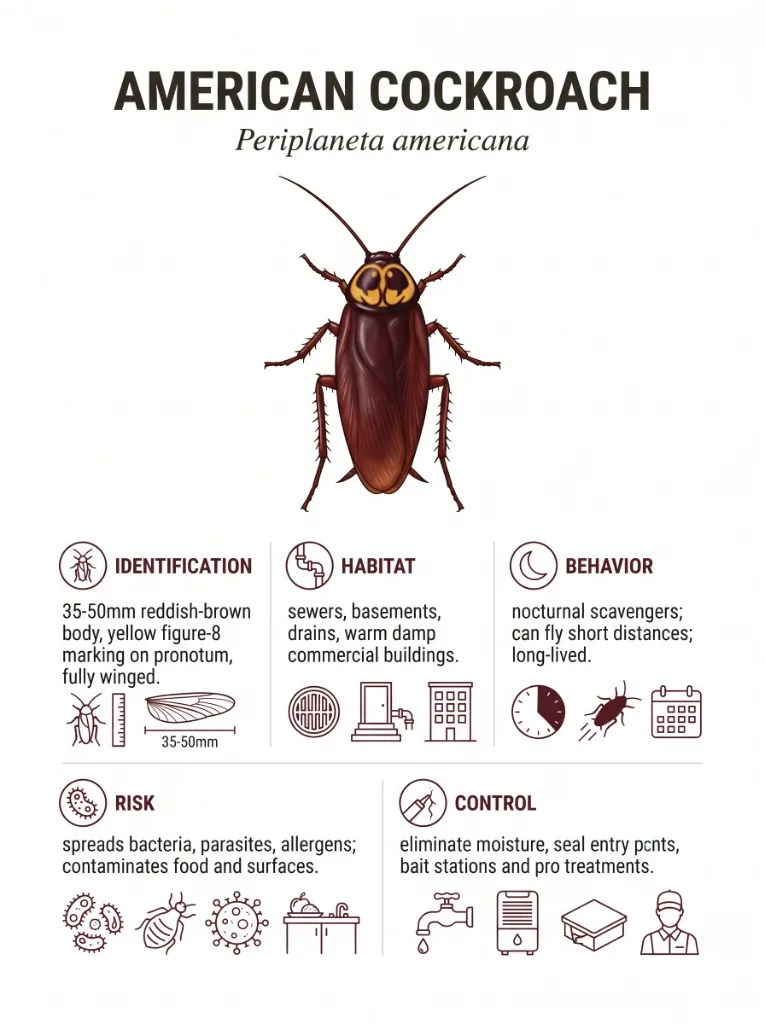
Smokybrown vs. American Cockroach

These two species overlap in the Triangle and look similar at a glance, but treatment focus differs:

  • Smokybrown — 32-38 mm, uniformly dark mahogany-brown to black, glossy, NO yellow figure-8. Strong flyer, attracted to light. Harbors in canopy, mulch, gutters, attics.
  • American — 35-50 mm, reddish-brown, distinctive yellow figure-8 behind the head. Prefers sewers, drains, ground-level harborage.

Smokybrown control emphasizes gutter cleanliness, tree-line proximity, attic sealing, and outdoor lighting; American cockroach control emphasizes sewers, drains, and crawl-space moisture. A licensed inspection settles which species is driving your problem.

Biology & Habitat

Smokybrown adults live about a year. Females produce dark, ridged egg capsules — about 11-14 mm — glued near food or moisture. Nymphs take about a year to reach adulthood under Triangle outdoor conditions.

Their preferred habitat is elevated, humid, and rich in decaying plant material: tree holes, gutter leaf litter, dense ivy on exterior walls, mulch beds, palmetto and yucca thatch, and any attic with humidity and organic debris. They tolerate less moisture stress than American cockroaches — meaning smokybrowns can persist in drier microhabitat where Americans cannot — but they are more sensitive to heat and cold, so they retreat to protected harborage in temperature extremes.

How They Get Into Triangle Homes

  • Attracted to porch and garage lights at night, then walk in through opened doors.
  • Fly into open garages during hot summer evenings.
  • Enter through soffit gaps and unscreened gable/attic vents.
  • Enter through unscreened chimneys.
  • Ride in on firewood carried inside for the season.
  • Enter through gaps at roofline utility penetrations.
  • Enter through poorly-sealed garage-door corners.

Homes with mature tree canopy, ivy on exterior walls, or leaf-clogged gutters see the highest smokybrown pressure.

Signs of Smokybrown Activity

  • Dark cockroaches on porch, patio, or garage floor in the morning after summer nights.
  • Cockroaches on window screens attracted to interior lights.
  • Egg capsules glued in attic corners, garage rafters, or shed interiors.
  • Droppings in gutters, attic spaces, or under mulch beds.
  • Cockroaches flying to porch or garage lights at night — very characteristic of this species.

Because they are outdoor-based, indoor sightings often happen one at a time rather than as a population — but repeat sightings mean an outdoor harborage close to the house.

Why the Triangle Suits Them

Central NC's tree canopy, humid summers, mature landscape features, and traditional home designs (attics with soffit and gable vents, wood-shake or wood-trim accents, chimneys, wrap-around porches with lighting) are ideal smokybrown habitat. Older neighborhoods with heavy tree cover — Hope Valley, Trinity Park, older Chapel Hill, Duke Forest, older Raleigh in-town — see the highest pressure. Newer subdivisions with cypress or pine mulch and heavy landscape planting are also strong producers.

Peak indoor-visitor season is late June through early September, especially after warm humid evenings and following heavy rainfall.

Our Treatment & Prevention Approach

  • Perimeter and roof-level assessment — mulch beds, gutter conditions, attic vents, soffits, chimney tops, ivy, tree-canopy proximity.
  • Exterior residual treatments along foundation, mulch bed edges, base of downspouts, and shrub bases.
  • Attic treatments for smokybrown harborage — dust or targeted residual in known corners.
  • Gutter cleaning recommendations — leaf-choked gutters are a major smokybrown harborage.
  • Lighting recommendations — replace bright white porch/garage bulbs with yellow or motion-activated fixtures to reduce attraction.
  • Attic vent screening and soffit sealing where entry points are found.
  • Ongoing quarterly perimeter service for chronic-pressure properties.

Every plan is scoped with a personalized quote based on the property's tree cover, attic condition, and current sighting pattern.

Prevention Tips for Triangle Homeowners

  • Clean gutters at least twice a year — leaf litter in gutters is prime smokybrown habitat.
  • Remove ivy, wisteria, and other dense vines from exterior walls.
  • Screen attic and gable vents; add a proper chimney cap.
  • Pull mulch back at least 15 cm from the foundation.
  • Replace bright white exterior lights with yellow bug lights or motion-activated fixtures.
  • Trim tree limbs so no branch is within 1 meter of the roof.
  • Do not carry firewood inside days before you intend to burn it; store outdoors elevated off the ground.
  • Keep garage doors closed at dusk and after — porch/garage lights attract flying adults.

Frequently asked

Smokybrown Cockroach questions homeowners ask

How do I tell a smokybrown from an American cockroach?
Smokybrown adults are uniformly dark mahogany to black and lack the yellow figure-8 behind the head. American cockroaches are reddish-brown and have a distinct yellow figure-8 marking. Both are around the same length; the color and the head marking are the fastest field ID.
Are smokybrown cockroaches dangerous?
They carry the same general bacteria on their bodies that other roaches do — surface contamination is the main concern when they enter kitchens or bath areas. They do not aggressively bite, and their allergen impact is lower than German cockroach. The main issues are outdoor nuisance density and periodic indoor invasion.
Why do they fly into my porch every summer?
Smokybrowns are strongly attracted to lights, especially bright white lights, on humid summer nights. Switching to yellow bug bulbs, motion-activated fixtures, or lower-mounted lights dramatically reduces the attraction. Combining that with perimeter treatments and gutter cleanup usually resolves the seasonal issue.
Are they breeding in my attic?
They can — Triangle attics with humidity, leaf litter in gutters that spills into soffits, and unsecured vent screens will support smokybrown populations. Finding egg capsules in the attic is a strong indicator. Attic treatment plus vent sealing is the correct response.
Will one treatment fix the problem?
A perimeter treatment plus attic and gutter attention will substantially reduce sightings. Because smokybrown pressure often comes from surrounding tree cover and neighboring yards you can't control, an ongoing quarterly exterior service is the standard recommendation for lasting reduction.

Related pests

More in cockroaches

Browse all pests