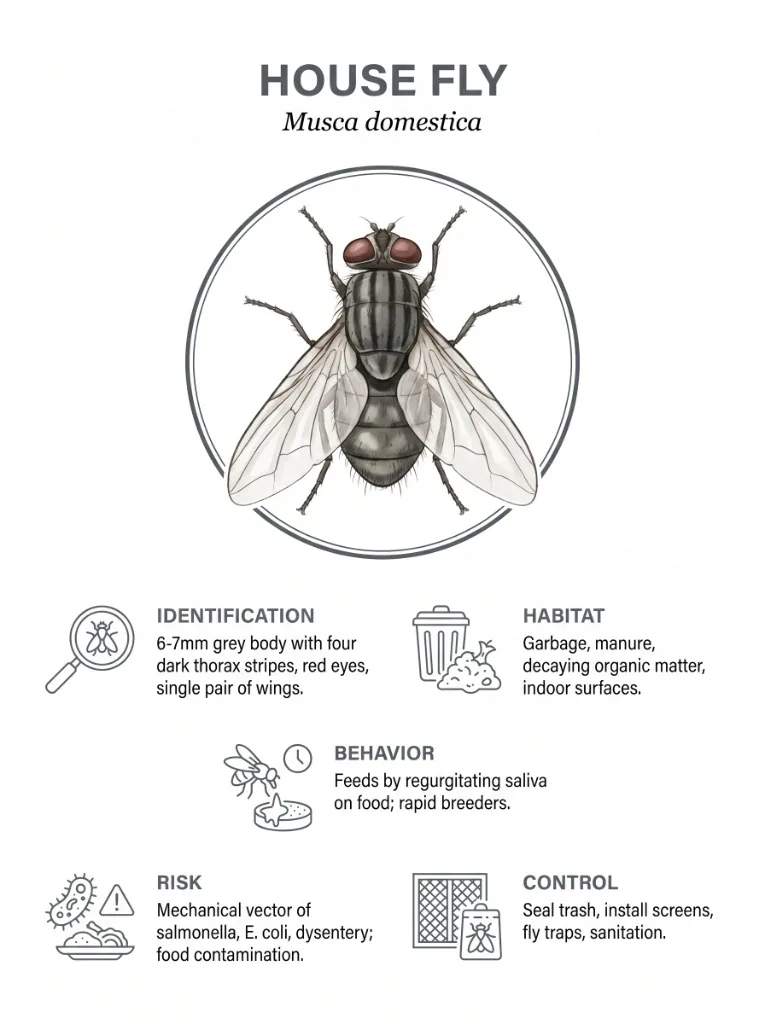
House Fly (Musca domestica) identification infographic showing size, habitat, behavior, risk, and control
Moderate concern

House Fly — Identification & Control

Musca domestica

Size
6–7 mm
Category
Flies & Flying Pests

About the house fly

The common house fly is the everyday grey fly most people picture when they think "fly" — roughly a quarter inch long, with four distinct dark stripes running down the thorax and a pair of prominent red eyes. House flies feed by regurgitating saliva onto solid food to liquefy it before consuming it, a habit that makes them unusually effective at mechanically transferring pathogens: salmonella, E. coli, and the bacteria behind dysentery have all been documented being carried by house flies moving between garbage, manure, and food surfaces.

House flies breed remarkably fast — a female can lay several hundred eggs across her lifespan, and a full life cycle from egg to adult can complete in under two weeks in warm weather. That speed is exactly why an ignored problem escalates quickly: what looks like one or two nuisance flies today can become a genuine infestation within a couple of weeks if a breeding source (garbage, pet waste, decaying organic matter) is left unaddressed nearby.

Quick ID

6–7 mm grey body with four dark thorax stripes, red eyes, single pair of wings.

In the Triangle

Year-round across the Triangle; peak in summer.

Think you have house flys?

Free inspection from a licensed Castle Exterminators technician — Durham, Chapel Hill, Raleigh, Cary & the Triangle. We'll confirm the species and recommend a treatment plan.

Request Free Inspection (919) 606-8686
Where House Flies Breed and Why It Matters

House flies lay eggs in decaying organic matter — garbage, pet waste, compost, spoiled food, and manure are all prime breeding sites. Outdoor sources near the home, like uncovered trash cans or neglected pet waste in a backyard, are common contributors to indoor fly pressure even when the kitchen itself is spotless, which is why fly control has to look beyond just the indoor space.

House Fly Prevention & Control

Sanitation is the foundation of house fly control: keep trash cans covered and emptied regularly, clean up pet waste promptly, and address any decaying organic matter around the property. Screens on doors and windows and a properly sealed threshold block adult entry, while fly traps and strips catch flies already inside. For persistent infestations tied to an outdoor breeding source, identifying and eliminating that source is essential — traps alone will not resolve an ongoing supply of new adults.

Frequently asked

House Fly questions homeowners ask

How dangerous are house flies really?
House flies are a genuine mechanical disease vector, capable of transferring salmonella, E. coli, and other pathogens from contaminated surfaces onto food and kitchen counters, so persistent indoor activity is a legitimate hygiene concern, not just a nuisance.
Why do I have house flies if my kitchen is clean?
The breeding source is often outdoors — an uncovered trash can, pet waste, or a neglected compost pile can supply a steady stream of flies into a spotless kitchen through open doors or small gaps.

Related pests

More in flies & flying pests

Browse all pests