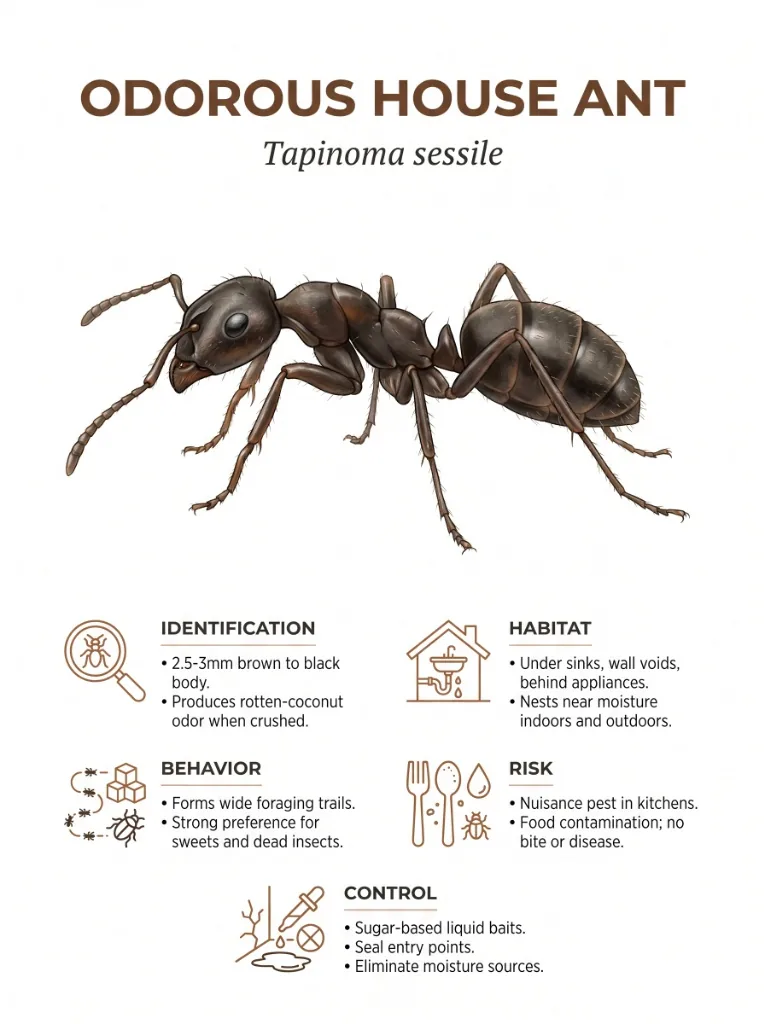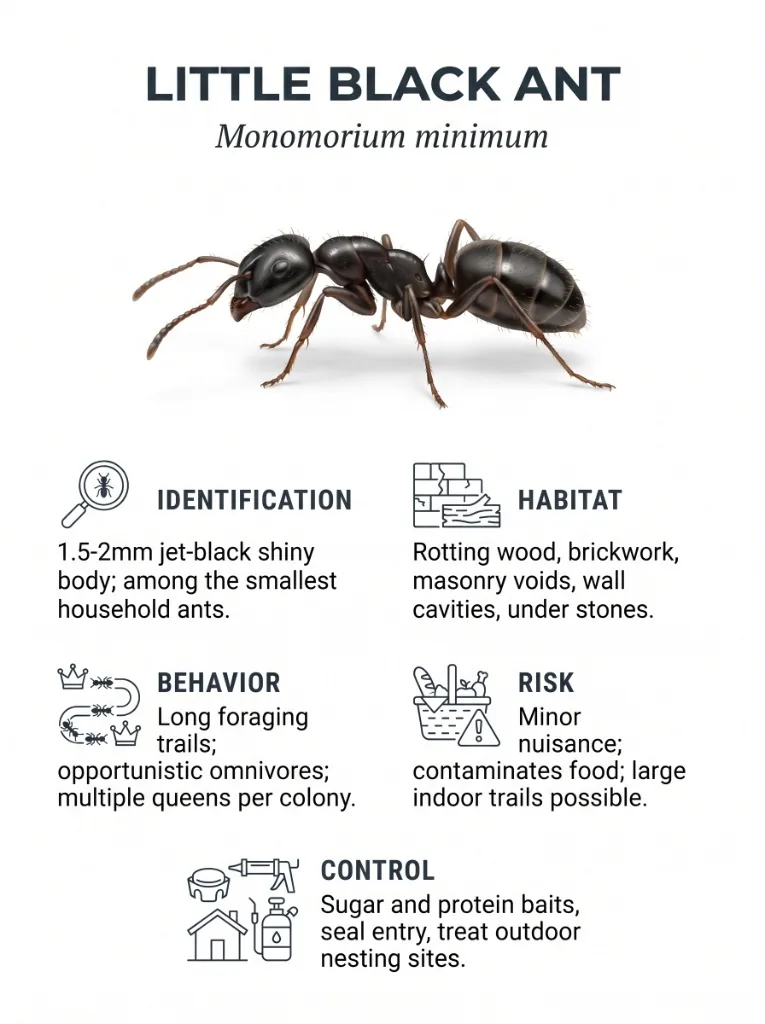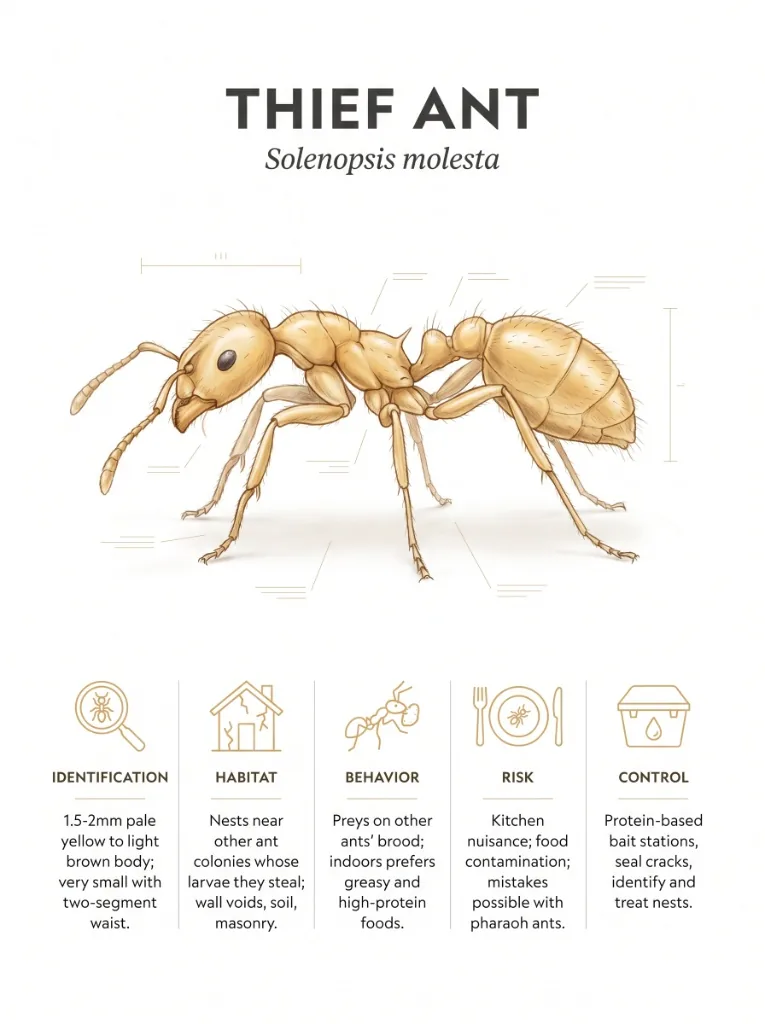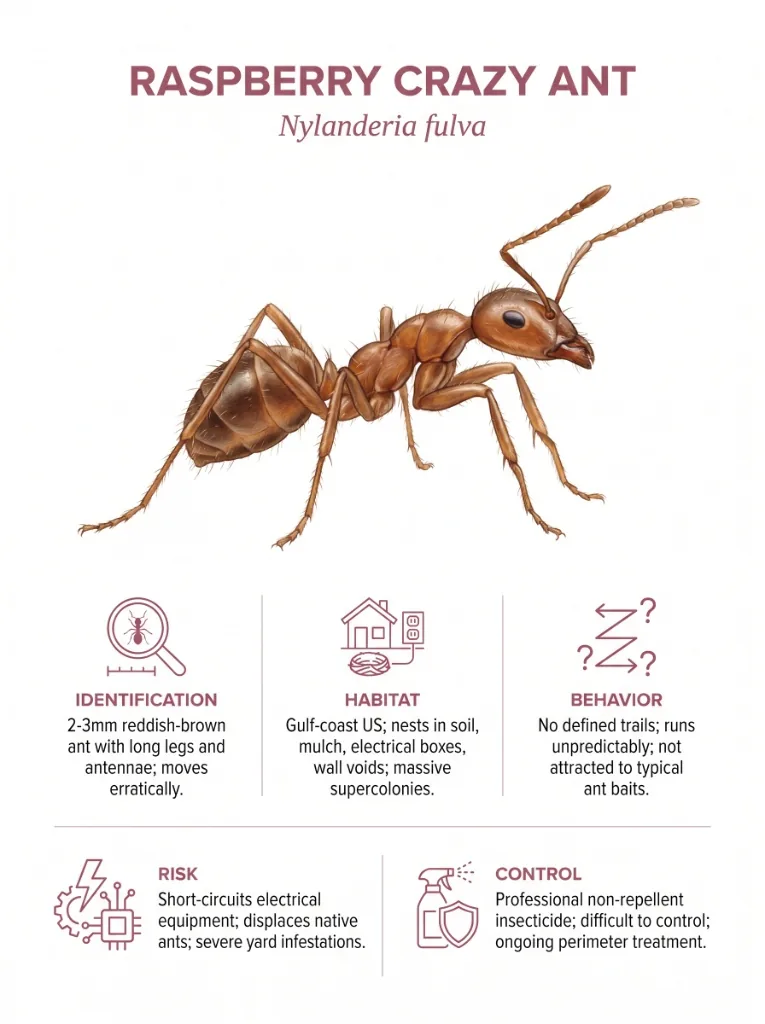
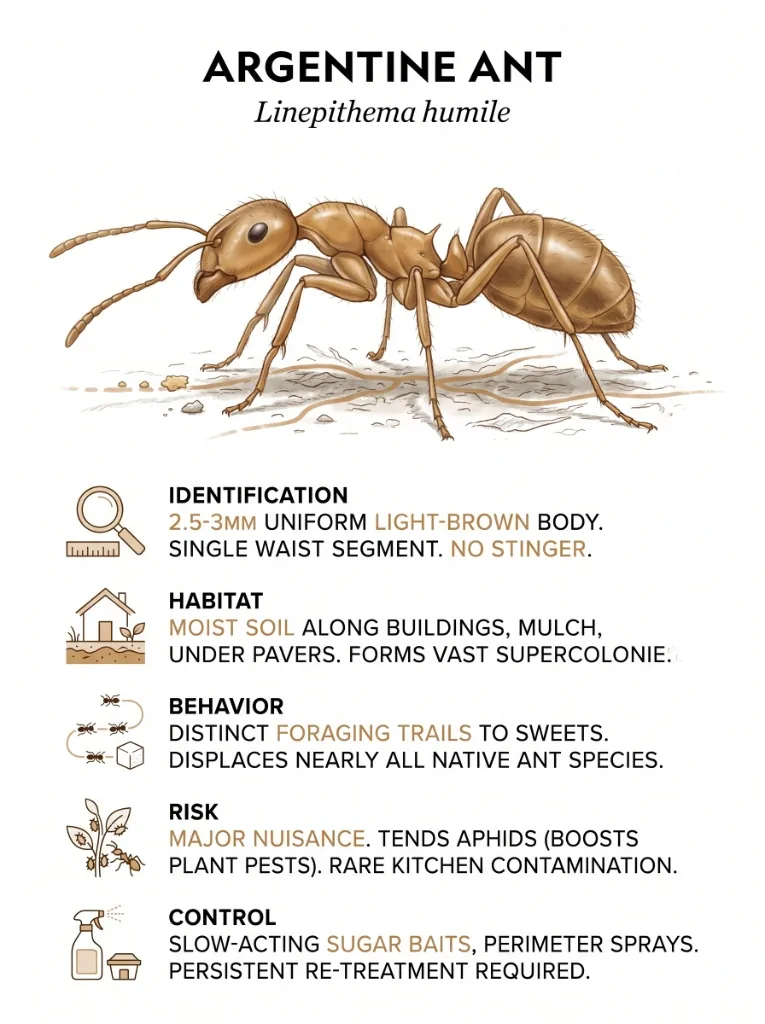
Argentine Ant (Linepithema humile) identification infographic showing size, habitat, behavior, risk, and control
Moderate concern

Argentine Ant — Identification & Control

Linepithema humile

Size
2.5–3 mm
Category
Ants

About the argentine ant

The Argentine ant (Linepithema humile) is an invasive species that has established itself across much of the southern US and increasingly across the North Carolina Triangle. Workers are small (2.5-3 mm), uniformly light brown, and — like odorous house ants — form massive multi-queen colonies that connect into vast supercolonies. In heavily-infested Triangle yards, we have documented interconnected Argentine ant networks spanning entire blocks.

Argentine ants are a genuine control challenge because their colony structure defeats most single-property treatments — kill the colony on your lot, and workers reoccupy from neighboring yards within weeks. Effective control almost always requires ongoing exterior perimeter service using slow-acting sugar baits and non-repellent perimeter residuals. This is not an ant category where DIY has a good success rate.

Quick ID

2.5–3 mm uniform light-brown body, single waist segment, no stinger.

In the Triangle

Present in southern NC; in the Triangle they appear sporadically but can establish in landscaping mulch beds.

Think you have argentine ants?

Free inspection from a licensed Castle Exterminators technician — Durham, Chapel Hill, Raleigh, Cary & the Triangle. We'll confirm the species and recommend a treatment plan.

Request Free Inspection (919) 606-8686
Identifying Argentine Ants

  • Size & color — 2.5-3 mm, uniformly light brown (never dark or black).
  • Body — single-node waist; smooth (not hairy) body.
  • No smell when crushed — distinguishes them from odorous house ants of similar size.
  • Behavior — extremely well-defined trails, often several ants wide; workers move in a fast steady pace with little of the odorous-house-ant jerkiness.
  • Aggression toward other ant species — Argentine ants displace native ants aggressively. If a yard that had diverse ant species suddenly has ONLY one type, Argentine ants are a top suspect.

Supercolony Biology

Argentine ants are the classic invasive supercolony species. Multiple queens per nest, multiple nest sites, and — crucially — colonies from separated nests recognize each other as friendly rather than fighting for territory. That means the 'colony' on your property may functionally extend across several neighboring yards, sharing workers and cooperating.

This is why single-property treatments have poor long-term success. Eliminate the Argentine ants on your lot and workers simply redistribute from the surrounding network. Effective residential Argentine ant control uses baiting programs that let workers carry the active back into the network, treating what you can reach from your property.

What Argentine Ants Do to a Yard

Beyond the household nuisance, Argentine ants disrupt local ecology in ways that show up in a Triangle yard:

  • They protect and 'farm' plant-feeding aphids and scale insects on ornamentals, ruining garden plants over time.
  • They displace native ants that would otherwise handle other pest species — one aggressive Argentine population can push out ten native species.
  • They enter homes in enormous trails during summer, especially seeking moisture during hot dry stretches.
  • They contaminate food and are attracted to pet food, sugary spills, and any moisture.

Yards with declining ornamental plants, worsening aphid infestations, and increasingly heavy ant pressure are the classic Argentine ant profile.

Where They Nest Around Triangle Homes

  • Under mulch beds against the foundation.
  • Under landscape rocks, timbers, and stepping stones.
  • In irrigation-box interiors.
  • Along foundation cracks and expansion joints.
  • Under garbage bins, recycling bins, and outdoor storage.
  • In dense ground cover — ivy, pachysandra, mondo grass.
  • Occasionally in wall voids adjacent to moist conditions.

Peak indoor invasion aligns with hot dry weather (July-September) as they seek indoor moisture.

Our Argentine Ant Control Approach

  • Extensive perimeter inspection — Argentine ant treatment starts by understanding how far the network extends around and onto your property.
  • Non-repellent perimeter residuals that ants walk through and carry back into the network.
  • Sugar-based bait stations along trails — Argentine ants are strongly attracted to sugar baits.
  • Landscape adjustment recommendations — pulling mulch back, reducing dense ground cover against the foundation.
  • Ongoing service on a defined cycle — Argentine ant control is a maintenance discipline, not a one-shot event. This is the ant species most likely to require ongoing quarterly service to keep results in place.

Every plan is scoped with a personalized quote based on network extent and property conditions.

Prevention Tips

  • Pull mulch beds back at least 15 cm from the foundation.
  • Reduce dense ground cover (ivy, pachysandra) against exterior walls.
  • Address any aphid or scale-insect infestation on ornamentals — Argentine ants defend them.
  • Fix outdoor faucets, irrigation leaks, and gutter downspout drainage.
  • Do not leave outdoor pet food bowls.
  • Seal exterior utility penetrations.
  • Recognize that if neighboring yards are untreated, ongoing service on your property is the realistic path to keeping them at bay.

Frequently asked

Argentine Ant questions homeowners ask

How is an Argentine ant different from an odorous house ant?
Both are small (2.5-3 mm), single-node ants that form big colonies. The difference: Argentine ants are LIGHT brown and do NOT smell when crushed; odorous house ants are DARK brown and release a distinct rotten-coconut smell. Argentine ants also displace other ant species aggressively — if all other ants disappeared from your yard first, that is a strong signal.
Why do Argentine ants keep coming back after I treat?
Their supercolony structure connects across property lines. Eliminating them on your lot doesn't eliminate the surrounding network — workers simply redistribute from neighboring yards. Ongoing perimeter service is usually needed to keep the pressure suppressed.
Can I do anything about them myself?
Yard sanitation (mulch pulled back, no outdoor pet food, ornamental aphid control) helps at the margins. But the aggressive multi-queen supercolony structure defeats most DIY approaches. Professional baiting and non-repellent perimeter treatment is the practical answer.
Are they harmful to my garden?
Yes — they actively defend aphids and scale insects on ornamentals, ruining plants over time. Yards with declining ornamentals plus heavy ant pressure are the classic Argentine ant profile. Treating the ants often improves garden plant health as a downstream benefit.
Do they bite or sting?
Argentine ants can bite if handled but do not sting meaningfully and are not medically significant. The impact is nuisance, contamination, and garden damage — not injury.

Related pests

More in ants

Browse all pests