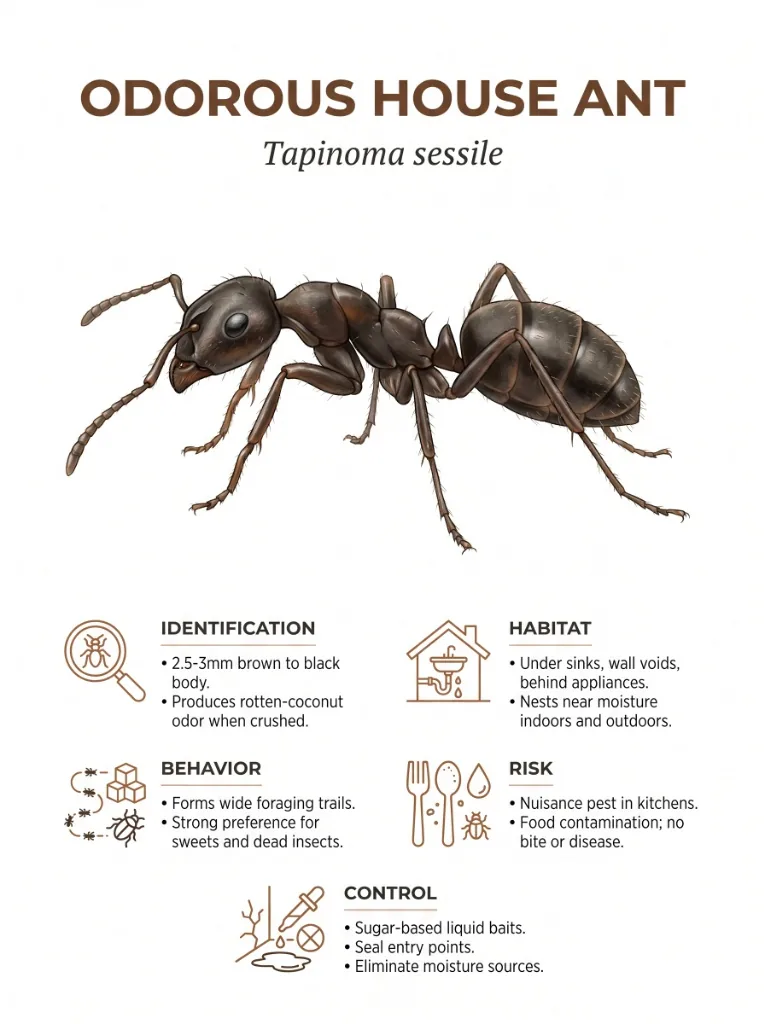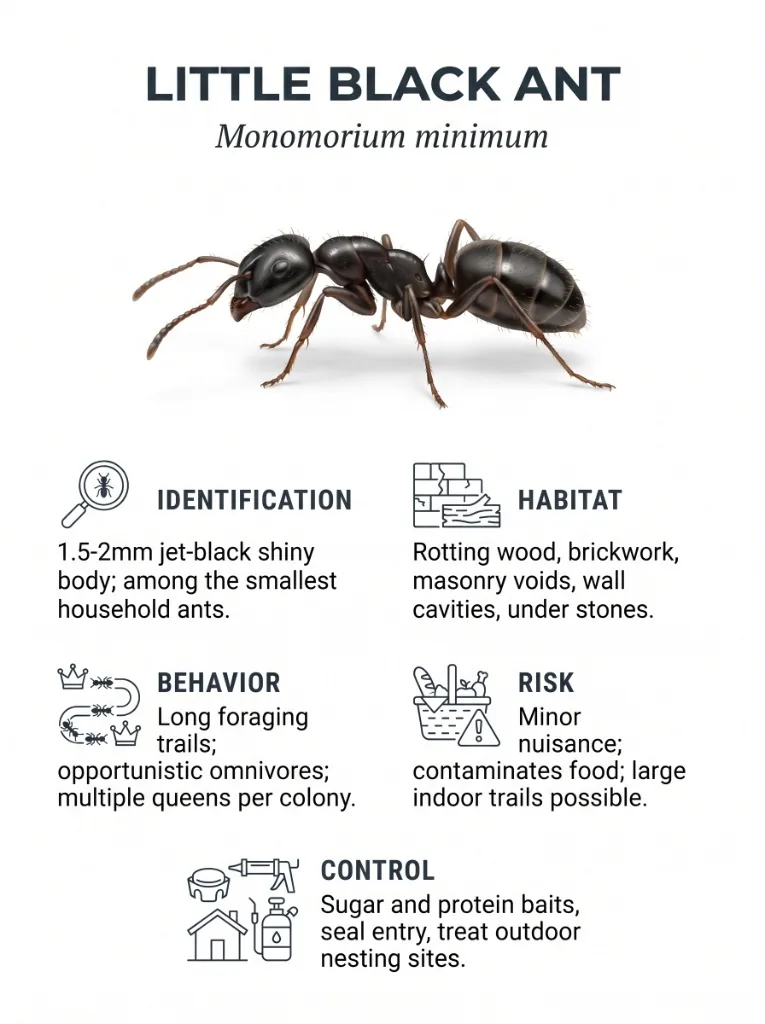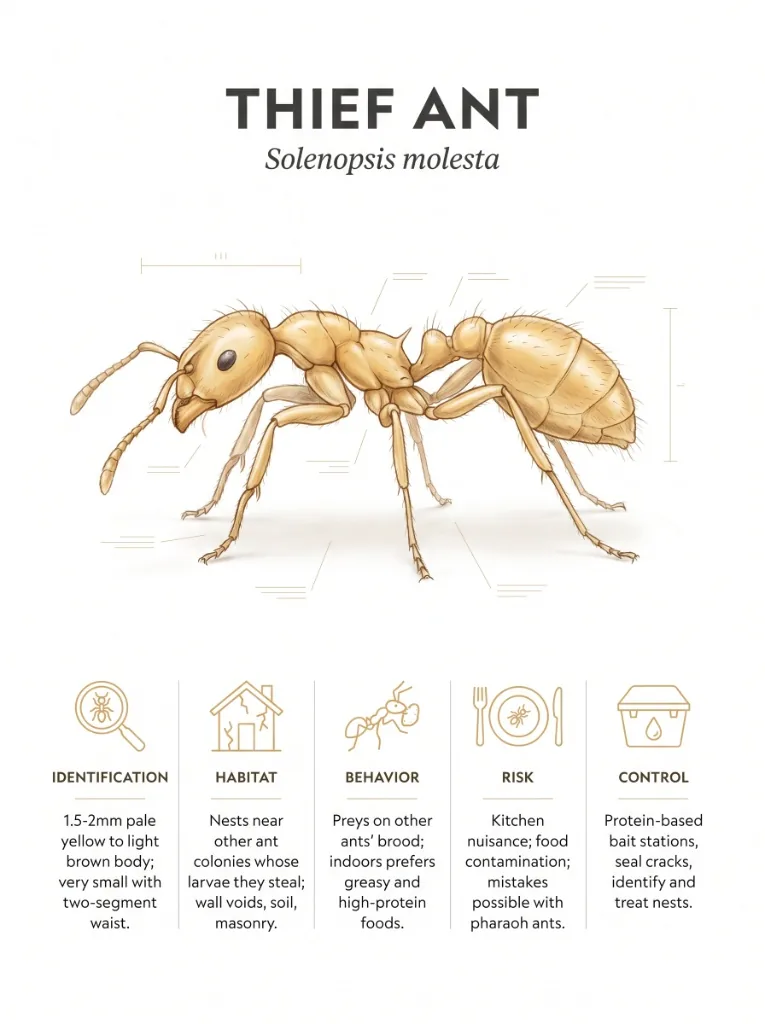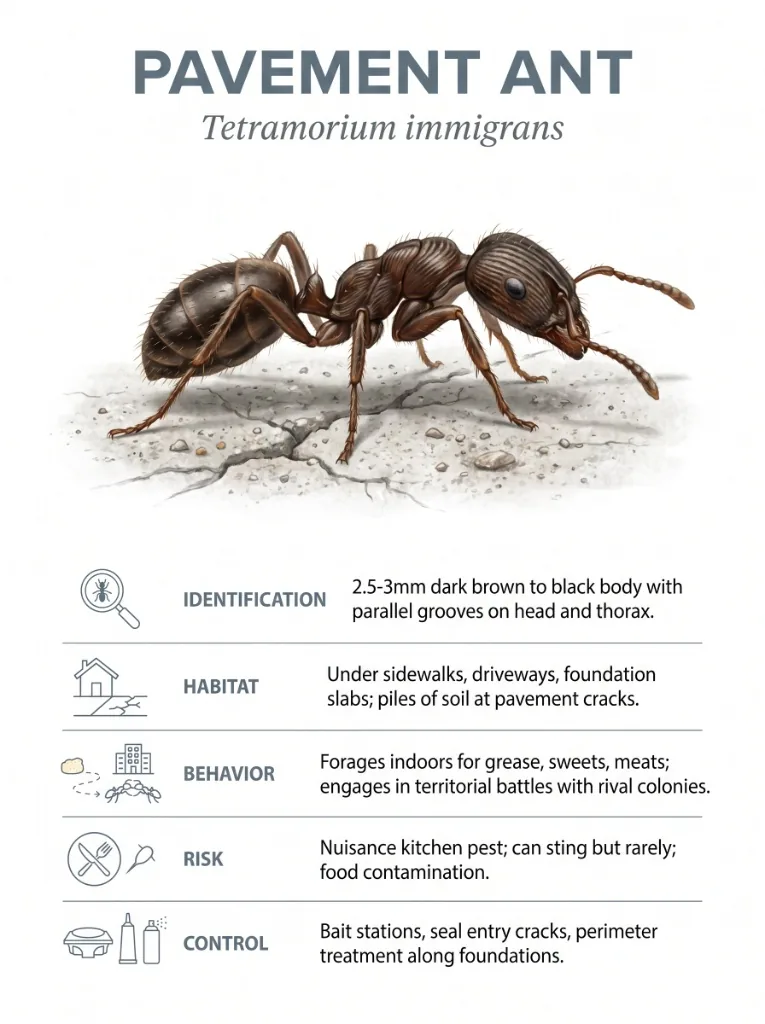
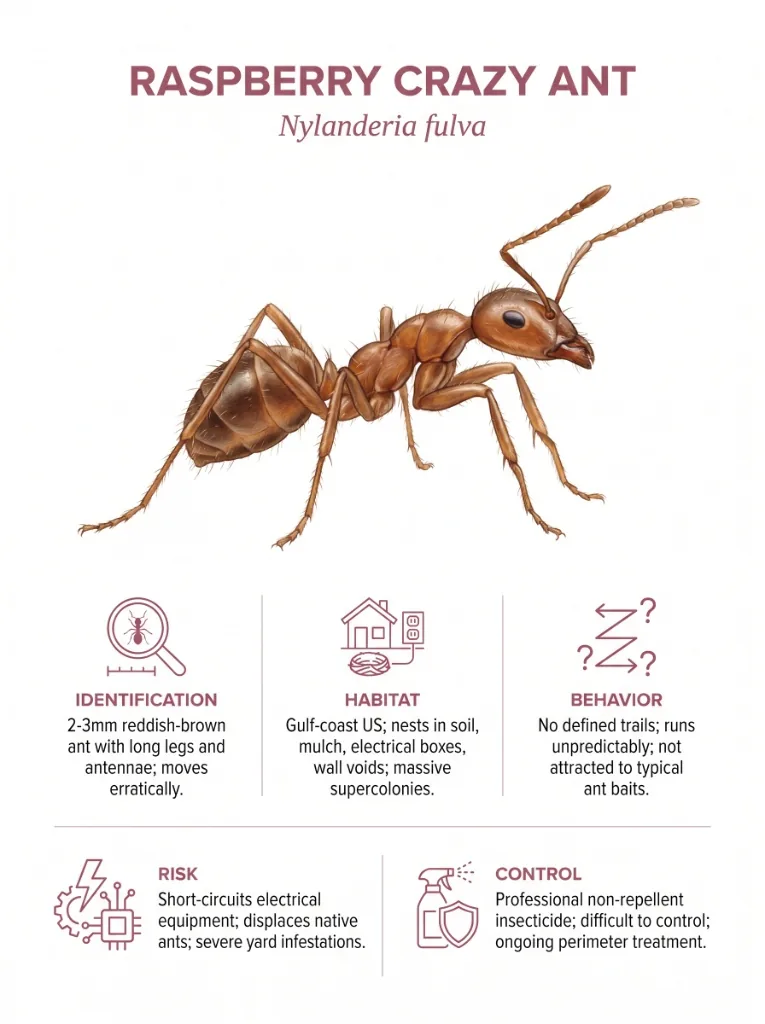
Raspberry Crazy Ant (Nylanderia fulva) identification infographic showing size, habitat, behavior, risk, and control
Moderate concern

Raspberry Crazy Ant — Identification & Control

Nylanderia fulva

Size
2–3 mm
Category
Ants

About the raspberry crazy ant

The tawny (raspberry) crazy ant (Nylanderia fulva) is a relatively recent invasive species in North Carolina and one of the most disruptive when it establishes. Adults are 2-3 mm, uniformly reddish-brown to golden-brown, notably hairy, and famous for erratic 'crazy' movement — workers do not follow orderly trails the way most ants do, instead running in fast unpredictable patterns.

Raspberry crazy ants are still expanding across NC, currently established in scattered Triangle populations. Where they show up, they arrive in overwhelming numbers — hundreds of thousands of workers, multiple queens, and interconnected networks that can span whole blocks. They are also documented to damage electrical equipment by nesting inside electronics and shorting circuits — reported HVAC unit failures, transformer failures, and even smart-home electronics damage have been tied to them in Gulf Coast states.

Quick ID

2–3 mm reddish-brown ant with long legs and antennae; moves erratically.

In the Triangle

Mostly a Gulf-coast pest; rare in the Triangle, but worth identifying if you see ants behaving unusually.

Think you have raspberry crazy ants?

Free inspection from a licensed Castle Exterminators technician — Durham, Chapel Hill, Raleigh, Cary & the Triangle. We'll confirm the species and recommend a treatment plan.

Request Free Inspection (919) 606-8686
Identifying Raspberry Crazy Ants

  • Size & color — 2-3 mm, uniformly reddish-brown to golden-brown.
  • Hairy body — distinctly hairy under magnification, unlike smooth-bodied Argentine ants of similar size.
  • Movement — the fastest field ID. Workers move erratically in fast unpredictable directions, not the orderly trails of most ants. When disturbed they explode outward in all directions.
  • Sheer numbers — where established, they occur in hundreds of thousands. Small populations are unusual.
  • Electronics attraction — inexplicably, they nest inside electronic housings and cause damage. If you have small ants inside a failed piece of outdoor electronics, tawny crazy ants are on the differential.

Why They Are Such an Invasive Threat

Raspberry/tawny crazy ants combine several traits that make them uniquely disruptive:

  • Multiple queens per nest with vast interconnected supercolony structure — orders of magnitude beyond Argentine ants.
  • Extremely high population density where established — outnumbering all other ant species combined.
  • Aggressive displacement of fire ants (which is at least an ecological positive against fire ants, but the net effect is a monoculture of an even worse pest).
  • Documented damage to electrical equipment: outdoor AC units, transformer boxes, irrigation controllers, meter housings, and vehicle wiring.
  • Resistance to standard fire ant treatments; require adjusted control approaches.

Where they establish, they change the yard's ecology dramatically — and often within a single season.

Where They Nest

  • Under mulch, leaf litter, and landscape debris.
  • Under stones, timbers, and hardscape.
  • Inside outdoor electrical equipment — AC condensers, transformer boxes, irrigation controllers, meter housings.
  • Along foundation walls.
  • Under and around potted plants.
  • In tree hollows and along dense ground cover.

They rarely nest deep inside homes but readily invade during summer, and their nesting in outdoor electrical equipment is a distinct property-damage concern.

Our Treatment Approach

Raspberry crazy ant control is more intensive than most other ant species:

  • Comprehensive perimeter and yard-wide assessment — mapping the extent of the network on the property.
  • Non-repellent perimeter residuals at higher application intensity than typical ant treatments.
  • Broadcast granular baits across the yard where legal and appropriate.
  • Direct treatment of nest sites including outdoor electrical enclosures (with power off, following appropriate safety protocol).
  • Ongoing service on a defined cycle — this ant category will not be resolved by a one-time treatment. Expect ongoing management.
  • Landscape adjustment — significant mulch and debris reduction, leaf-litter removal.

Every plan is scoped with a personalized quote based on infestation extent and property conditions.

Prevention Tips

  • Reduce mulch layers to no more than 5-8 cm deep; keep beds pulled back from foundation.
  • Remove landscape debris, log piles, and old stone piles from the yard.
  • Inspect outdoor AC condenser units seasonally for ant infestation.
  • Keep firewood elevated and at least 20 feet from the house.
  • Do not import mulch, potted plants, or landscape stone from established-infestation areas without inspection.
  • If you suspect crazy ants, get a professional ID quickly — they spread fast, and early treatment is dramatically easier than late.

Frequently asked

Raspberry Crazy Ant questions homeowners ask

How do I know if I have raspberry crazy ants vs. some other small brown ant?
The movement is the giveaway. Most ants follow orderly trails; crazy ants run in fast erratic patterns and explode outward when disturbed. They are also always in very high numbers where established — small populations are unusual. If you have a lot of small reddish-brown ants moving in random fast directions, get a professional ID immediately.
Are they in North Carolina yet?
Yes — established in scattered Triangle locations and expanding. The main gulf-coast infestation started decades ago; NC populations are more recent and still spreading. Early detection matters — where they are caught early, control is far easier than in fully-established populations.
Do they actually damage electronics?
Yes — documented damage to outdoor AC condensers, irrigation controllers, transformer boxes, and vehicle wiring in gulf-coast states. The mechanism is not fully understood — nesting inside enclosures, mass die-off inside contacts causing arcing — but the property damage is real.
Will regular pest control keep them out?
For properties near known infestations, ongoing intensified perimeter service is a reasonable preventive measure. For properties with confirmed infestation, expect an extended intensive treatment program — this ant does not respond to one-shot treatments the way most others do.
Do they bite or sting?
They can bite mildly if handled but do not sting meaningfully and are not medically significant. The concerns are sheer population density, disruption of native fauna, and electronics damage.

Related pests

More in ants

Browse all pests