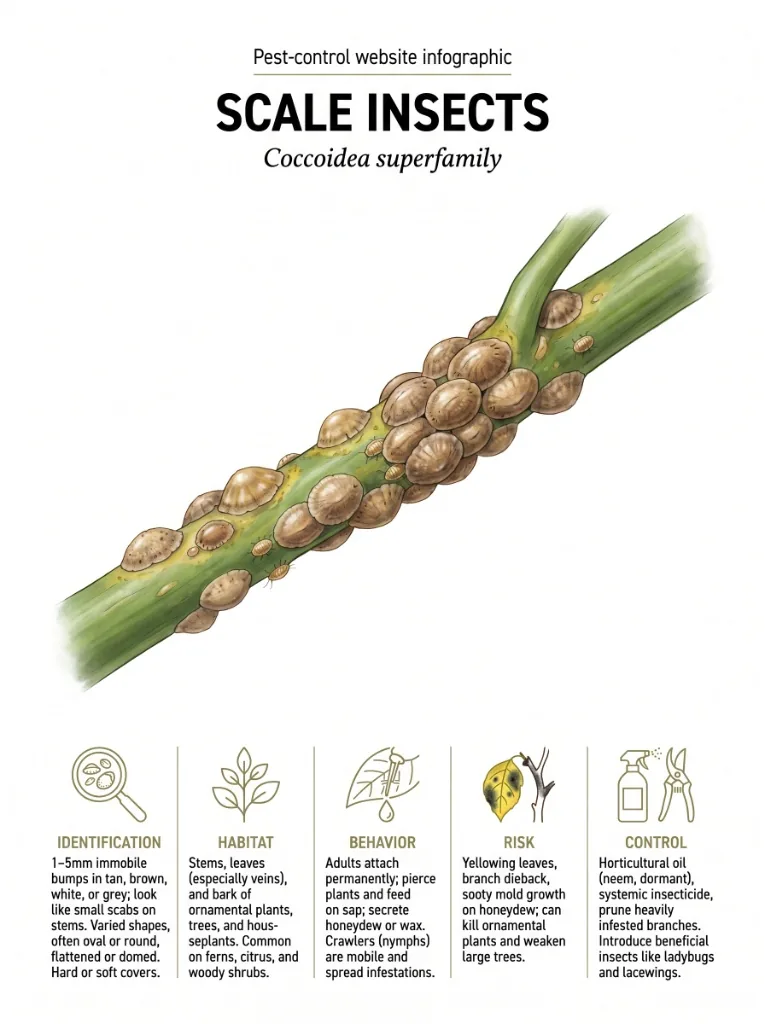
Scale Insects (Coccoidea superfamily) identification infographic showing size, habitat, behavior, risk, and control
Low concern

Scale Insects — Identification & Control

Coccoidea superfamily

Size
1–5 mm
Category
Garden & Outdoor

About the scale insects

Scale insects are one of the more unusual garden pests homeowners encounter, because for most of their life cycle they simply do not look alive. Adult females settle permanently on plant stems, leaves, and bark, and secrete a waxy or shell-like covering over their body — appearing as small, immobile bumps in tan, brown, white, or grey that many people initially mistake for a plant disease, scab, or bark texture rather than an insect.

Beneath that protective covering, scale insects pierce plant tissue and feed continuously on sap, much like aphids, and many species secrete the same sticky honeydew that grows black sooty mold on leaves and anything beneath the plant. Heavy scale populations cause yellowing leaves, reduced vigor, and branch dieback over time, and their protective wax coating makes them notably harder to control with contact sprays than most other sap-feeding pests, since the covering shields them from direct contact once established.

Quick ID

1–5 mm immobile bumps in tan, brown, white, or grey; look like small scabs on stems.

In the Triangle

Common on Triangle ornamentals, especially azaleas, camellias, and houseplants brought outside in summer.

Think you have scale insectss?

Free inspection from a licensed Castle Exterminators technician — Durham, Chapel Hill, Raleigh, Cary & the Triangle. We'll confirm the species and recommend a treatment plan.

Request Free Inspection (919) 606-8686
Where Scale Insects Attack Triangle Plants

Scale insects favor ornamentals, citrus, and houseplants moved outdoors for the summer, with azaleas and camellias among the most commonly affected Triangle landscape plants. They concentrate along stems, the undersides of leaves, and especially along leaf veins, and a heavy infestation is often noticed first by the sooty mold growing on honeydew below the plant rather than the insects themselves.

Treating a Scale Insect Infestation

Because the adult's waxy covering resists contact insecticides, timing matters — horticultural oil applied during the vulnerable crawler stage, before the protective covering hardens, is far more effective than treating established adults. Systemic insecticides, absorbed by the plant and delivered to feeding insects through the sap, are effective against established populations that resist contact sprays. Pruning heavily infested branches removes concentrated populations directly, and encouraging beneficial ladybugs, which prey on scale insects, provides ongoing natural suppression for lighter infestations.

Frequently asked

Scale Insects questions homeowners ask

How do I know if those bumps on my plant are scale insects and not a disease?
Try gently scraping one with a fingernail — if it lifts off cleanly and reveals a soft body or empty shell underneath, it is a scale insect rather than a fungal or bacterial growth, which would not lift off in the same way.
Why won't regular insecticide spray get rid of my scale insects?
Adult scale insects are protected by a waxy or shell-like covering that blocks direct contact with most sprays. Effective control requires either targeting the vulnerable crawler stage with horticultural oil or using a systemic insecticide the plant absorbs internally.

Related pests

More in garden & outdoor

Browse all pests